A $32 million infrastructure project in downtown Chicago to create dedicated bus lanes and improve bus shelters is done, but the city of Chicago and its police are not enforcing the laws they made to make that system run.


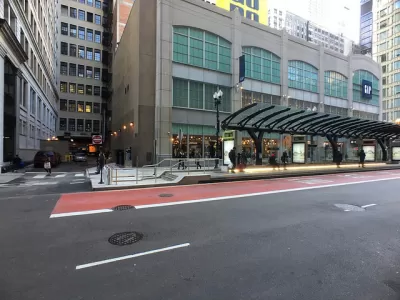
Downtown Chicago built a system of dedicated bus lanes called "Loop Link," but the lanes are often blocked by cars and bikes. "A Freedom of Information Act request was filed to learn how often police have cited drivers for driving in the CTA lanes. Each violation is supposed to come with a $90 fine. The finding of that investigation: "Never," report Chris Coffey and Katy Smyser for NBC Chicago. Interlopers in these lanes causes a lot of inconsistency in transit times and makes a bus transit system that has been losing ridership even less attractive.
The city invested heavily in the system to make their shrinking city more attractive and to serve its tax payers. "Constructing the Loop Link, including its designated lanes, raised platforms, bus stations, and tracker monitors, cost taxpayers nearly $32 million," write Coffey and Smayser. If the city that designed the system doesn't enforce the rules that make the system run, the city can't get the most out of those dollars.
Read the full story: City Not Enforcing Traffic Laws to Help Loop Link Run Smoothly: Records

Bus/Bike Lanes Find Support in Chicago
A temporary bus/bike lane experiment could lead to permanent additions around the city.
Chicago Creates Incentives for Transit Oriented Developments Along Bus Routes
Mayor Rahm Emanuel's administration will expand its program to incentivize transit oriented development by including land around the 79th Street and Chicago Avenue bus routes.
Chicago Transit Authority Buses Inch Toward Prepay
A Chicago Transit Authority pilot program for prepayment is set to expand. Transit advocates can't wait for the agency to adopt the program around the city.

Planetizen Federal Action Tracker
A weekly monitor of how Trump’s orders and actions are impacting planners and planning in America.

California plans to bury El Niño’s downpour
If the state plays its cards right, it may be able to store a billion acre-feet of El Niño’s water in aquifers.

Desperate measures: Advocates weigh draining Lake Powell to fill Colorado River
Draining the reservoir could reduce evaporation losses by a couple hundred thousand acre-feet.

Los Angeles just elected an urban planner as its mayor
Transportation analysts are optimistic that Raman will be more aggressive in addressing transit issues than Bass.

Mamdani’s pied-à-terre tax survives legal challenge
A panel of judges found that the plaintiffs failed to demonstrate injury as a result of New York City's implementation of the tax.

Eastern Nebraska is running out of electricity
Data centers and electrification are straining eastern Nebraska’s grid, throttling economic development.

FREE Course: Walkable City 1: Why Walkability?
After describing his path towards focusing on walkability as the essence of good planning, Jeff Speck marches through his five principal reasons for making more walkable places.
Reinventing Malls: Planning Alchemy—Turning Gray Fields Into Gold
The course focuses on the opportunities and imperatives that shape reinvention of mall sites.

City of Rosemead
Rutgers University, Edward J. Bloustein School of Planning and Public Policy
One Hundred Miles
University of Michigan School for Environment and Sustainability (SEAS)
Hunter College, City University of New York (CUNY)
The Architects Foundation
City of Cambridge
Montrose County
The Pocatello Development Authority