Taking the bus might not feel as comfortable as going by car, but according to this research from Montreal, it's safer.


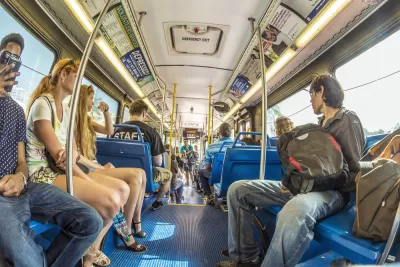
It's often said that it's statistically safer to ride a plane than drive a car, although it doesn't always feel that way. The same may be true for bus passengers. According to a recent study, bus riders in Montreal are only a third as likely to get injured on the road.
John Metcalfe writes, "By perusing police reports from 2001 to 2010, [researchers] found motorists on these routes had more than three times the injury rate of bus passengers. Buses were also safer for people sharing the road."
"[This] work backs up, on the city level, what's been known for some time on the macro scale. In the United States car occupants have a fatality rate 23 times greater than bus passengers, while it's respectively 11 and 10 times higher in Australia and Europe. [Researchers] suggest getting more people on public transit could make a large impact on public health." Of course, conditions vary from place to place, and further micro-scale research in the U.S. would be helpful.
Metcalfe also notes that these statistics cannot apply to bus drivers, whose jobs are often dangerous and unhealthy.
Read the full story: A Good Way to Avoid Injuries on the Road: Ride the Bus

Civil Rights Complaint for Providence's Kennedy Plaza Redesign
The state's plan to dismantle and reorganize its busiest bus plaza faces allegations of civil rights violations.
L.A. Metro Report Examines How Women Travel
Findings from a new study about the mobility needs and concerns of women in Los Angeles will inform future initiatives and planning.

Friday Funny: Souvenir Photos of Your New York City Bus Ride
A satirical post by ClickHole imagines a world where bus trips are treated like a trip to Disneyland.

Planetizen Federal Action Tracker
A weekly monitor of how Trump’s orders and actions are impacting planners and planning in America.

California plans to bury El Niño’s downpour
If the state plays its cards right, it may be able to store a billion acre-feet of El Niño’s water in aquifers.

Desperate measures: Advocates weigh draining Lake Powell to fill Colorado River
Draining the reservoir could reduce evaporation losses by a couple hundred thousand acre-feet.

Mamdani’s pied-à-terre tax survives legal challenge
A panel of judges found that the plaintiffs failed to demonstrate injury as a result of New York City's implementation of the tax.

Eastern Nebraska is running out of electricity
Data centers and electrification are straining eastern Nebraska’s grid, throttling economic development.

Seattle passes record-breaking transit services expansion
Proposition 1 will double the city’s transit tax to add 95,000 more bus trips and preserve 180,000 bus trips annually.

FREE Course: Walkable City 1: Why Walkability?
After describing his path towards focusing on walkability as the essence of good planning, Jeff Speck marches through his five principal reasons for making more walkable places.
Reinventing Malls: Planning Alchemy—Turning Gray Fields Into Gold
The course focuses on the opportunities and imperatives that shape reinvention of mall sites.

City of Rosemead
Rutgers University, Edward J. Bloustein School of Planning and Public Policy
One Hundred Miles
Hunter College, City University of New York (CUNY)
The Architects Foundation
University of Cincinnati Online
City of Cambridge
Montrose County
The Pocatello Development Authority