Colorado is the latest state to consider allowing people on bikes to pass through intersections more freely than cars.


John Wenzel reports on a bill in the Colorado State Legislature that would legalize the "Idaho Stop."
Senate Bill 93, introduced Jan. 18 by Sen. Andy Kerr, D-Lakewood, would permit a person riding a bike or “electrical-assisted bicycle” to pass through intersections without stopping if the rider “slows to a reasonable speed, yields to vehicles and pedestrians, and can safely proceed or make a turn.”
Much of Wenzel's coverage is devoted to explaining the rationale behind the bill, citing precedent and studies supporting the case for legalizing the Idaho Stop.
The law is commonly referred to in the biking community as the “Idaho stop” and is credited with reducing cycling-related injuries by 14.5 percent the year after it was implemented, with no change in fatalities, according to a 2010 study by Jason Meggs, a researcher at the University of California at Berkeley School of Public Health.
As expected, there are politicians who oppose the bill, and there are bike advocates excited about the possibility of the bill's passage. Wentzel is careful to allow both sides to state their case. With the bill, Colorado joins a handful of other states, and the District of Columbia, to debate similar regulations in recent years.
FULL STORY: Bill to let bicyclists roll through stop signs gains speed, but there are roadblocks ahead

Virginia Lawmakers Won't Let Cyclists Roll Through Stop Signs—Yet
The state legislature passed a bill calling for a study of the proposed law and its effects in other states.
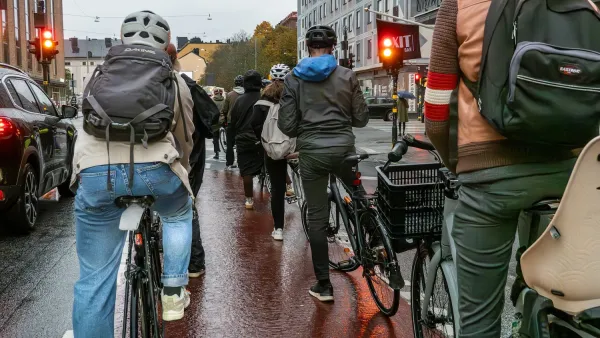
Cyclists may be Right to run Stop Signs and Red Lights. Here’s why
One researcher argues that the Idaho stop might not be such a bad idea after all.
Research Affirms Safety of ‘Idaho Stop’
Allowing cyclists to treat stop signs as yield signs does not negatively impact safety and can help people on bikes more effectively navigate roadways.

The state-sanctioned urbicide of Austin
People don’t kill cities. Freeways do.

US to reduce Colorado River water deliveries to Mexico
A new Colorado Treaty amendment reduces Mexico’s Colorado River water allocation by 250,000 acre feet.

New Jersey’s second-largest city bans standalone data centers
Jersey City will continue to allow co-location facilities, such as those meant for research institutions that store their own data.

Amtrak not solely to blame for New Jersey commuter rail's unreliability, report finds
A new study from the Garden State Initiative found that NJ Transit’s budget grew 20% across a 4 year period, but reliability declined significantly over the same period.

EPA erases limits on planet-warming pollution from power plants
Under Monday’s plan, power plants would still have some limits on how much mercury, arsenic and other contaminants they can emit.

Phoenix announces new on-demand transit service, more frequent RAPID buses
Both new services will launch in October, and are part of Phoenix's Project Effective Access Solutions for Easing Congestion.

FREE Course: Walkable City 1: Why Walkability?
After describing his path towards focusing on walkability as the essence of good planning, Jeff Speck marches through his five principal reasons for making more walkable places.
Reinventing Malls: Planning Alchemy—Turning Gray Fields Into Gold
The course focuses on the opportunities and imperatives that shape reinvention of mall sites.

Eagle County Government
Harvard University Graduate School of Design
Nashville Planning Department
The Architects Foundation
University of Cincinnati Online
The Pocatello Development Authority
The Urban Renewal Agency of the City of Pocatello
Journal of the American Planning Association