It's the antithesis of what former President Obama and his predecessors did when they gave federal lands and waters more protection. But don't blame Trump's executive actions for this one (not yet, anyway), as it's being proposed by Congress.


For people and organizations who care about preservation of federal lands, this may come as a surprise, as it did to The Wilderness Society.
“We didn’t see it coming. I think it was sneaky and underhanded. It exemplifies an effort to not play by the rules,” said Alan Rowsome, senior director of government relations at The Wilderness Society. “This is the worst Congress for public lands ever.”
"At stake are areas managed by the Bureau of Land Management (BLM), National Forests and Federal Wildlife Refuges, which contribute to an estimated $646bn each year in economic stimulus from recreation on public lands and 6.1m jobs," reports Heather Hansman for The Guardian.
The Congressional devaluation of national property is the most far-reaching legislative change in a recent push to transfer federal lands to the states. Because of the Republican majority in Congress, bills proposing land transfers could now swiftly diminish Forest Service and BLM lands across the country..
Hansman details the losses to the federal budget and loss of public access. Furthermore, there are also substantial maintenance costs to these public lands that cash-strapped states may be unwilling to assume, which provides a powerful incentive to sell them, so it's not just an issue of transferring public lands between federal and state governments.
Opponents fear that local governments, especially in states with small budgets, won’t be able to invest in management and will sell off land to make money. Last summer, the Forest Service was spending $240m a week to suppress wildfires, and the Department of Interior estimates the cost of deferred maintenance, like updating roads, at around $11bn.
In December, Wyoming Governor Matt Mead [R] said that transferring public land to his state was legally and financially impractical. He cited firefighting costs on public land as something that the state budget wouldn’t have room for.
A blog by The Wilderness Society spotlights federal legislation advanced by Utah Congressmen Jason Chaffetz and Rob Bishop, both Republicans, to "sell off 3 million acres of public lands."
Hat tip to Loren Spiekerman.
Read the full story: Congress moves to give away national lands, discounting billions in revenue

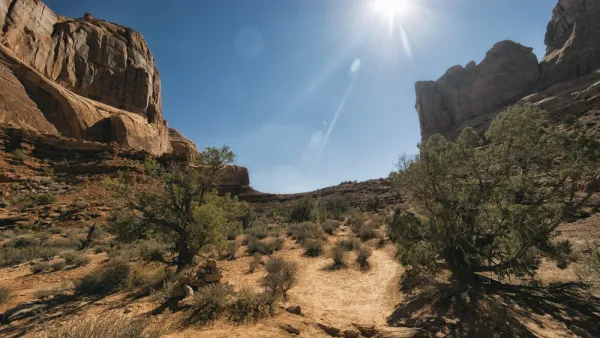
Federal Lands Transfer Bill Withdrawn
Facing backlash from hunting and angling groups, Utah Rep. Jason Chaffetz withdrew legislation that would have transferred millions of acres of federal lands to state governments in the West. But news wasn't good for other environmental bills.
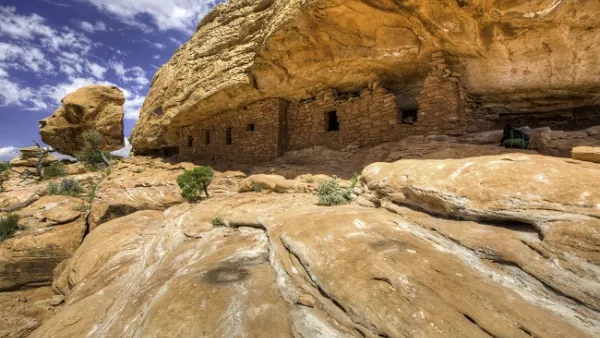
Antiquities Act Executive Order Calls for Review of Large Designations
The Executive Order does not roll back the Antiquities Act nor rescind any designations made by presidents Clinton, George W. Bush, or Obama, but does call for their review if over 100,000 acres. President Trump feels that the act has been misused.

Another Environmental Regulation Rollback Finalized by Trump Administration
A one-year suspension of an Obama-era rule to reduce methane emissions from oil and gas drilling on Federal and Indian lands will increase global warming and reduce federal revenue. Trump took action after Congress failed to repeal the rule.

Planetizen Federal Action Tracker
A weekly monitor of how Trump’s orders and actions are impacting planners and planning in America.

California plans to bury El Niño’s downpour
If the state plays its cards right, it may be able to store a billion acre-feet of El Niño’s water in aquifers.

Chicago breaks ground on $3 billion megadevelopment
The new neighborhood, titled Foundry Park, will one day host 3,700 residences.

Satanic Place Names
From streams and lakes to valleys and canyons, I mapped more than 1,000 places named after the Devil.

California High-Speed Rail Authority CEO resigns after $600,000 scandal
Under Ian Choudri, the authority used taxpayer dollars to fund first class flights and trips to nightclubs.

Want to study the Missouri River? Soon, you may need unanimous approval from 10 states
Legislation would require 10 governors’ permission to study or build projects moving water outside the basin.

FREE Course: Walkable City 1: Why Walkability?
After describing his path towards focusing on walkability as the essence of good planning, Jeff Speck marches through his five principal reasons for making more walkable places.
Reinventing Malls: Planning Alchemy—Turning Gray Fields Into Gold
The course focuses on the opportunities and imperatives that shape reinvention of mall sites.

City of Rosemead
Rutgers University, Edward J. Bloustein School of Planning and Public Policy
One Hundred Miles
Hunter College, City University of New York (CUNY)
The Architects Foundation
University of Cincinnati Online
City of Cambridge
Montrose County
The Pocatello Development Authority