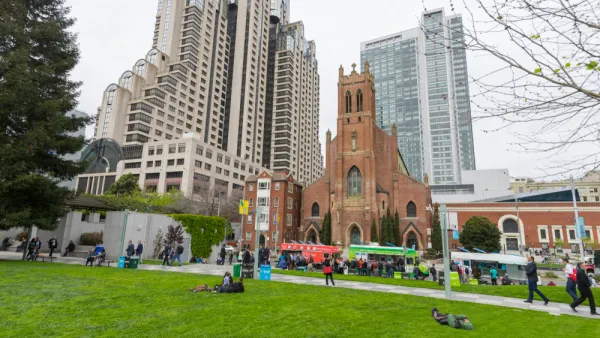
Central SoMa ("South of Market") in San Francisco will soon have a new neighborhood plan. Planners hope zoning changes will reap rewards in property values and public benefits.


"The city [of San Francisco] hopes that the new neighborhood plan considered for the roughly 17 block-area dubbed Central SoMa will pump property values way up between Second and Fourth Street," reports Adam Brinklow.
That ambitious target is included in a report by analysts at San Francisco-based Seifel Consulting [pdf], prepared for the San Francisco Planning Department. The report "singled out a handful of model sites" and "crunched how the proposed zoning changes and subsequent new development would affect their values," explains Brinklow. The zoning changes would be included in the Central SoMa Plan, currently at the Draft Environmental Impact Report stage of the planning process.
The case made by the report includes the big carrot of 50 percent of all increased property values going to public benefits, which "presents a fairly rosy picture of higher density under the plan." San Francisco, of course, is a city famous for its grassroots resistance to development, so it will be interesting to see if the case made by this report finds any traction.
Read the full story: City hopes SoMa development will pump millions into land values—and public benefits

San Francisco's Massive 'Central SoMa Plan' Faces Litigation
The Central SoMa Plan took more than seven years of planning and debate to approve. A new lawsuit, expected to be just the first of many, threatens to erase all that work.

San Francisco Approved an Expanded Central SoMa Plan
The Central SoMa Plan, which sets development goals for a key swath of Downtown San Francisco, got bigger as it moved through a lengthy approval process.

San Francisco Plans for 82,000 New Housing Units
California housing regulators have granted preliminary approval for the city of San Francisco’s housing element as mandated by the state’s Regional Housing Needs Allocation process.

Planetizen Federal Action Tracker
A weekly monitor of how Trump’s orders and actions are impacting planners and planning in America.

California plans to bury El Niño’s downpour
If the state plays its cards right, it may be able to store a billion acre-feet of El Niño’s water in aquifers.

Chicago breaks ground on $3 billion megadevelopment
The new neighborhood, titled Foundry Park, will one day host 3,700 residences.

California High-Speed Rail Authority CEO resigns after $600,000 scandal
Under Ian Choudri, the authority used taxpayer dollars to fund first class flights and trips to nightclubs.

Want to study the Missouri River? Soon, you may need unanimous approval from 10 states
Legislation would require 10 governors’ permission to study or build projects moving water outside the basin.

Desperate measures: Advocates weigh draining Lake Powell to fill Colorado River
Draining the reservoir could reduce evaporation losses by a couple hundred thousand acre-feet.

FREE Course: Walkable City 1: Why Walkability?
After describing his path towards focusing on walkability as the essence of good planning, Jeff Speck marches through his five principal reasons for making more walkable places.
Reinventing Malls: Planning Alchemy—Turning Gray Fields Into Gold
The course focuses on the opportunities and imperatives that shape reinvention of mall sites.

City of Rosemead
Rutgers University, Edward J. Bloustein School of Planning and Public Policy
One Hundred Miles
Hunter College, City University of New York (CUNY)
The Architects Foundation
University of Cincinnati Online
City of Cambridge
Montrose County
The Pocatello Development Authority