Austin planners are considering a law designed to ensure bus service performance by requiring drivers to allow buses to merge after making a stop, but transit advocates point to a body of research that casts doubt on the efficacy of such laws.


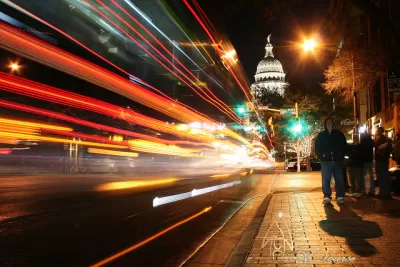
Caleb Pritchard reports from Austin: "Mayor Steve Adler’s sales pitch for his successful $720 million transportation bond promised the creation of new bus pullouts along major city corridors so that, in his words, 'cars can keep on going when the bus pulls over.'"
That's where the challenge arises. "Transit advocates and the Capital Metropolitan Transportation Authority countered that notion with concerns that endless platoons of zooming vehicles would pin buses inside the pullouts, thus kneecapping City Council’s directive to staff to use the bond money both to ease congestion and improve transit operations," according to Pritchard.
Thus a new state or local law is under consideration to "require drivers to yield to buses attempting to re-enter the flow of traffic," but the track record of such laws in other states and cities has not made a case for the potential success of the law in speeding up transit service.
Read the full story: Corridor plans could yield new traffic law, but buses might not benefit as promised

Big Changes Coming for Austin Transit System
After a long survey process, Austin looking to update its transit system focusing on frequency on its busiest routes.
King County Metro adds 3,000 weekly bus trips, more connections to rail
King County Metro and Sound Transit are both making major adjustments to their bus networks to improve light rail connectivity across the region.
Texas DOT report outlines options for commuter rail between Austin and San Antonio
Amtrak currently operates just one trip per day between the two cities.

Planetizen Federal Action Tracker
A weekly monitor of how Trump’s orders and actions are impacting planners and planning in America.

California plans to bury El Niño’s downpour
If the state plays its cards right, it may be able to store a billion acre-feet of El Niño’s water in aquifers.

Chicago breaks ground on $3 billion megadevelopment
The new neighborhood, titled Foundry Park, will one day host 3,700 residences.

California High-Speed Rail Authority CEO resigns after $600,000 scandal
Under Ian Choudri, the authority used taxpayer dollars to fund first class flights and trips to nightclubs.

Want to study the Missouri River? Soon, you may need unanimous approval from 10 states
Legislation would require 10 governors’ permission to study or build projects moving water outside the basin.

Desperate measures: Advocates weigh draining Lake Powell to fill Colorado River
Draining the reservoir could reduce evaporation losses by a couple hundred thousand acre-feet.

FREE Course: Walkable City 1: Why Walkability?
After describing his path towards focusing on walkability as the essence of good planning, Jeff Speck marches through his five principal reasons for making more walkable places.
Reinventing Malls: Planning Alchemy—Turning Gray Fields Into Gold
The course focuses on the opportunities and imperatives that shape reinvention of mall sites.

City of Rosemead
Rutgers University, Edward J. Bloustein School of Planning and Public Policy
One Hundred Miles
Hunter College, City University of New York (CUNY)
The Architects Foundation
University of Cincinnati Online
City of Cambridge
Montrose County
The Pocatello Development Authority