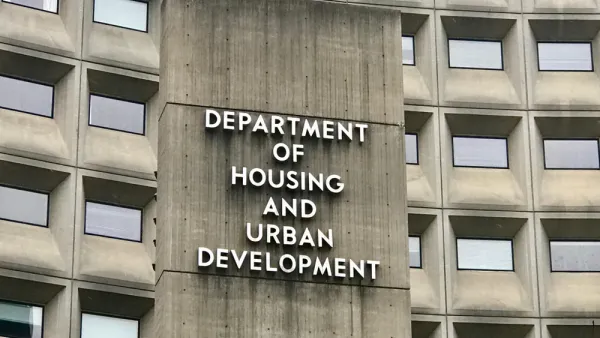
Rules protecting minorities' access to housing have been strengthened under the Obama administration. That progress could be lost under a HUD Secretary who opposes Fair Housing altogether.


Fair-housing rules will soon be in the hands of a developer who discriminated against black tenants—President-elect Trump—an anxious CityLab piece by Kriston Capps notes.
Some of Trump’s reported contenders for HUD Secretary are firmly opposed to policies that aim to expand access to good housing in a field historically stacked against people of color and the working class. Kriston Capps notes especially Robert Astorino, who has in some ways built a career out of attacking housing rules. Retired neurosurgeon and former Republican presidential candidate Ben Carson, who in 2015 called fair housing a "noose," has this week been confirmed as Trump's pick for the position.
In a Housing Department governed by these beliefs, recent policy changes meant to strengthen what has until now been weak federal anti-discrimination housing policy could be targeted for revision or even repeal.
The first is Affirmatively Furthering Fair Housing—already a target of conservative pushback—which requires cities to assess their own low-income housing practices and compliance with the Fair Housing Act before qualifying for federal housing funds.
Aspects of AFFH have yet to be implemented: the Assessment of Fair Housing tool for state governments, for example, will not receive final approval by the Office of Management and Budget before January 20. If AFFH is to succeed, President-elect Trump will have to finish what President Obama started.
The second is a Supreme Court decision affirming that "disparate impact" of housing policies on different racial groups is a form of discrimination prohibited by the Fair Housing Act, regardless of whether it is an explicit goal.
Trump's pick could undermine this policy even if the Supreme Court doesn't actually overturn its decision—by simply not enforcing it. "The U.S. Department of Justice will be as pivotal to protecting fair-housing standards as HUD," Capps notes.
FULL STORY: What's at Stake in Trump's Pick to Lead HUD

HUD Plans to Revive Fair Housing Rule
The department is proposing an updated version of the Affirmatively Furthering Fair Housing rule, which requires local governments to take action to end residential segregation.

How to Fix Racist Housing Policies: Sue the Suburbs
Strengthening U.S. Department of Housing and Urban Development's civil rights enforcement could send a powerful signal to communities resistant to changing discriminatory housing rules.

The Unfounded Fears of Affordable Housing Opposition
Neither evidence nor experience support the fearful visions expressed by opponents to affordable housing development, according to a recent feature article for the New York Times.

Planetizen Federal Action Tracker
A weekly monitor of how Trump’s orders and actions are impacting planners and planning in America.

The state-sanctioned urbicide of Austin
People don’t kill cities. Freeways do.

US to reduce Colorado River water deliveries to Mexico
A new Colorado Treaty amendment reduces Mexico’s Colorado River water allocation by 250,000 acre feet.

5 New England states march closer to 800 megawatt wind energy project
Securing federal approval for the project may be complicated under the Trump administration, which has historically been hostile towards domestic wind power.

Baltimore to break ground on $50 million Transit Priority Project
The project will bring faster bus trips, safer streets and better bike connections to Baltimore.

Airbnb launches $250 million 'last-dollar financing' housing accelerator, makes first investment in Austin
The company will put $6.4 million towards affordable housing development in Texas’ capital.

FREE Course: Walkable City 1: Why Walkability?
After describing his path towards focusing on walkability as the essence of good planning, Jeff Speck marches through his five principal reasons for making more walkable places.
Reinventing Malls: Planning Alchemy—Turning Gray Fields Into Gold
The course focuses on the opportunities and imperatives that shape reinvention of mall sites.


Eagle County Government
Harvard University Graduate School of Design
Nashville Planning Department
The Architects Foundation
University of Cincinnati Online
The Pocatello Development Authority
The Urban Renewal Agency of the City of Pocatello
Journal of the American Planning Association