Three sales tax measures in Fulton County all won on Nov. 8. Two city ballot measures sets a course for investment in public transit and active transportation for Atlanta, while Fulton County will invest in road projects to reduce traffic congestion.


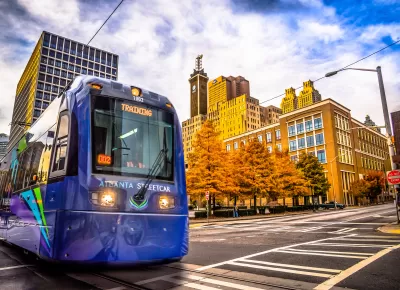
Among the Tax Foundation's "top state tax ballot initiatives to watch in 2016" were "two transportation special purpose local option sales and use tax (TSPLOSTs) referenda and one MARTA referendum [PDF]," wrote Joseph Henchman, Scott Drenkard, Nicole Kaeding, Jared Walczak, and Morgan Scarboro on Oct. 18. [Election results.]
- A 0.75 percent sales tax increase in Fulton County outside the city of Atlanta for five years to fund transportation improvements <52.7% yes>
- A 0.4 percent sales tax increase in the city of Atlanta for five years to fund transportation improvements like the Atlanta BeltLine <68% yes>
- A 0.5 percent sales tax increase in the city of Atlanta to expand MARTA's bus and rail system <71% yes>
Let's start with Atlanta:
"Tonight, voters approved two historic proposals to authorize the City of Atlanta and the Metropolitan Atlanta Rapid Transit Authority (MARTA) to modernize, expand and enhance our city’s transportation system," declared Mayor Kasim Reed on Tuesday at 11:30 PM.
Over the next five years, the City of Atlanta will build miles of Complete Streets projects, designing our streets so that they work for everyone – pedestrians, bikers and motorists.
We will synchronize traffic signals, invest in sidewalks and pedestrian infrastructure, and build new bike paths. We will purchase the remaining land we need to complete the Atlanta BeltLine, putting us in a strong position to compete for federal dollars and accelerate transit construction along the 22-mile pathway.
And from MARTA, as reported by Arielle Kass and Leon Stafford for The Atlanta Journal-Constitution:
“The first thing we will do is roll out more bus service very, very quickly, because the planning on that has already been done,” said Robbie Ashe, chairman of MARTA’s board of directors. “We can put new routes in places where there are not routes currently..."
The MARTA tax will raise $2.5 billion over 40 years, while the Atlanta tax will collect between $280 million and $320 million over five years. In the rest of Fulton County, the five-year tax will raise as much as $655 million.
A list of bus improvements, light and heavy rail projects, and Pedestrian/ADA/Bicycle Improvements is included in this fact sheet [PDF] .
And from the Fulton County Board of Commissioners:
"I am ecstatic," said Chairman John H. Eaves. "We worked so hard for so long to get the 14 mayors of Fulton County to work together and agree to map out the future of transportation in Fulton County. Thank you to the voters for saying 'yes.' This is a game changer and will begin to end our traffic nightmares."
"At the Atlanta Regional Commission, the three successful votes tell “a very compelling story about how we’re investing in ourselves,” said Mike Alexander, director of the Center for Livable Communities, report Kass and Stafford. Last month, ARC released a survey showing that transportation is the region's top priority.
The region's "transportation schism" between city and suburbs is not unique to Fulton County. King County exhibited a similar split when the suburbs rejected a transit tax that Seattle voters supported in 2014.
Another observation is that the success of the three measures marks a dramatic turnaround from July 2012 when over 60 percent of Atlanta metro ares voters rejected the one percent sales tax for $6.14 billion in transportation projects, although city voters supported it. The loss of the historic measure was "being framed as a victory for anti-government Tea Party allies and a loss for the region's economy," wrote Jonathan Nettler for Planetizen.
Also in The Atlanta Journal-Constitution:
- Tax increase approval may signal voter support of MARTA turnaround, Nov. 9, 2016
- Fulton, Atlanta transportation taxes appear to win; MARTA approved, Nov. 9, 2016
- MARTA’s expansion, BeltLine completion on November ballot, Oct. 21, 2016
Related in Planetizen:
- Election Roundup: Planning's Big Day at the Ballot Box, November 9, 2016
- Atlanta and Suburbs to Hold Separate Transportation Sales Tax Votes in November, July 11, 2016
- A Transportation Schism in the Atlanta Region, April 5, 2016
-
Atlanta Rejects Transpo Tax, August 1, 2012
-
Tomorrow's Transit Tax Vote is a Historic Day for Atlanta, July 30, 2012
FULL STORY: MARTA, Fulton, Atlanta transportation projects on fast track post vote

Review of November 2016 Transportation Ballot Measures
About 50 transportation measures appeared on local ballots on November 8, 2016. To date, Planetizen reviewed outcomes in nine regions in six states. Here we compare the measures in terms of revenue, taxes, projects, and reasons for failure.
Survey Gives Atlantans a Voice on Future Transit Projects
Survey says...More MARTA.
Atlanta and Suburbs to Hold Separate Transportation Sales Tax Votes in November
The 13 suburban cities of Fulton County agreed to a roads-only, .75-cent sales tax measure that needs to be approved by the county, while Atlanta voters will decide on a MARTA-only .50-cent sales tax. MARTA serves eight of the cities.

The state-sanctioned urbicide of Austin
People don’t kill cities. Freeways do.

US to reduce Colorado River water deliveries to Mexico
A new Colorado Treaty amendment reduces Mexico’s Colorado River water allocation by 250,000 acre feet.

New Jersey’s second-largest city bans standalone data centers
Jersey City will continue to allow co-location facilities, such as those meant for research institutions that store their own data.

Amtrak not solely to blame for New Jersey commuter rail's unreliability, report finds
A new study from the Garden State Initiative found that NJ Transit’s budget grew 20% across a 4 year period, but reliability declined significantly over the same period.

EPA erases limits on planet-warming pollution from power plants
Under Monday’s plan, power plants would still have some limits on how much mercury, arsenic and other contaminants they can emit.

Phoenix announces new on-demand transit service, more frequent RAPID buses
Both new services will launch in October, and are part of Phoenix's Project Effective Access Solutions for Easing Congestion.

FREE Course: Walkable City 1: Why Walkability?
After describing his path towards focusing on walkability as the essence of good planning, Jeff Speck marches through his five principal reasons for making more walkable places.
Reinventing Malls: Planning Alchemy—Turning Gray Fields Into Gold
The course focuses on the opportunities and imperatives that shape reinvention of mall sites.

Eagle County Government
Harvard University Graduate School of Design
Nashville Planning Department
The Architects Foundation
University of Cincinnati Online
The Pocatello Development Authority
The Urban Renewal Agency of the City of Pocatello
Journal of the American Planning Association