A new book examines the potential for coexistence between indigenous people and the post-development ethos of 21st century planning practice. Canada and Australia provide the case studies, but surely U.S. planners should also heed these lessons.


Paul Daley writes: "The vexed question of coexistence between Indigenous people and culture, and the settler state, is central to a new book, Planning for Coexistence? Recognizing Indigenous Rights Through Land-use Planning in Canada and Australia, by the Australian academic Libby Porter and Canadian Janice Barry."
The book considers case studies of coexistence experiments in urban contexts in Australia and Canada—examples of Indigenous communities "testing and renegotiating the use of traditional but now urbanised lands and how governments and planning authorities respond."
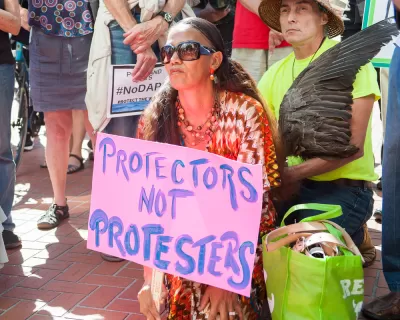
In case we need reminding of the need to improve the planning process for Indigenous people in the United States, Dakota Access Pipeline protests took a violent and dangerous turn this week, when North Dakota law enforcement sprayed protestors with water cannons on a sub-freezing evening.
Read the full story: Can Indigenous culture ever coexist with urban planning?

Cities Have Doubled in Size Globally in the Last 20 Years, Study Says
New research from China finds an incredible rate of urban expansion in North America and China.

An Academic Debate With Very Real Consequences: Land Use Regulations and the Cost of Housing
An article from the journal Urban Studies is inspiring debate and controversy over a year after publication, presenting opposing opinions on fundamental questions about how land use regulation affects the housing market.

How Houston Achieved Lot Size Reform
Nolan Gray of George Mason University and Adam A. Millsap of the Charles Koch Institute write about a recent article they authored in the Journal of Planning Education and Research.

Planetizen Federal Action Tracker
A weekly monitor of how Trump’s orders and actions are impacting planners and planning in America.

California plans to bury El Niño’s downpour
If the state plays its cards right, it may be able to store a billion acre-feet of El Niño’s water in aquifers.

Desperate measures: Advocates weigh draining Lake Powell to fill Colorado River
Draining the reservoir could reduce evaporation losses by a couple hundred thousand acre-feet.

Mamdani’s pied-à-terre tax survives legal challenge
A panel of judges found that the plaintiffs failed to demonstrate injury as a result of New York City's implementation of the tax.

Eastern Nebraska is running out of electricity
Data centers and electrification are straining eastern Nebraska’s grid, throttling economic development.

Seattle passes record-breaking transit services expansion
Proposition 1 will double the city’s transit tax to add 95,000 more bus trips and preserve 180,000 bus trips annually.

FREE Course: Walkable City 1: Why Walkability?
After describing his path towards focusing on walkability as the essence of good planning, Jeff Speck marches through his five principal reasons for making more walkable places.
Reinventing Malls: Planning Alchemy—Turning Gray Fields Into Gold
The course focuses on the opportunities and imperatives that shape reinvention of mall sites.

City of Rosemead
Rutgers University, Edward J. Bloustein School of Planning and Public Policy
One Hundred Miles
University of Michigan School for Environment and Sustainability (SEAS)
Hunter College, City University of New York (CUNY)
The Architects Foundation
City of Cambridge
Montrose County
The Pocatello Development Authority