The city of Milwaukee is repairing its streets and making them more bike and pedestrian friendly in the process.


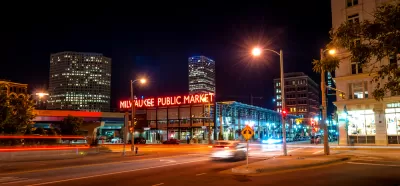
Milwaukee is undertaking a large-scale repair and update of its streets according to Dave Schlabowske in Urban Milwaukee. "The repairs are designed to last seven to 10 years, and the city has been able to resurface more than 60 miles of streets," Schlabowske tell us. Most of these streets include bike lanes.
Like many cities in the Midwest, Milwaukee's population has been flat or shrinking for more than 50 years. So many of these streets don’t carry the previous volume of traffic and are in need of modernization. "When an arterial street is resurfaced as part of the rapid fix program, the city evaluates current traffic volumes and is able to make some geometric updates if needed using the new pavement marking patterns. In many cases these roadways were widened decades ago to serve our then growing traffic volumes during Milwaukee’s industrial heyday when thousands of factory workers began driving to work in large factories," Schlaboske reports. These modernizations include making lanes more narrow to reduce speed of cars and to protect pedestrians, as well as adding bike lanes and making other improvements.
Schlabowske, who is involved with the Bike Federation of Wisconsin, says, "We applaud that commitment, but look forward to the first new protected bike lanes, neighborhood greenways network (sometimes called bicycle boulevards, or safe streets) or other next generation bicycle improvements to encourage more people to ride in Milwaukee." I agree.
Read the full story: City Streets Makeover Adds Bike Lanes

Portland Bike Lanes and the Danger of Half-Measures
Willamette's new bike lanes make for an important link in Portland's bike infrastructure, but building unprotected bike lanes on a high-speed street carries risk.
Milwaukee Road Safety Efforts Paying Off
The city is seeing fewer speeding violations after installing traffic calming measures and boosting enforcement to limit reckless driving.
Milwaukee to Install New 5.5-Mile Bike Lane
The project is part of a pledge to build 50 miles of new bike lanes by 2026.

Planetizen Federal Action Tracker
A weekly monitor of how Trump’s orders and actions are impacting planners and planning in America.

Amtrak, CN end decades-long dispute with eight-year agreement
The new operating agreement establishes an updated framework for the companies to work together, including processes to resolve disputes.

Judges permit Denver to divert 77,000 acre feet from the Colorado River for reservoir expansion
Overuse and climate change have caused the Colorado River’s water levels to plummet.

NYC DOT wants faster, more permanent street upgrades
The city is examining ways to build more concrete infrastructure without getting entangled in 'decades-long' projects.

'Something we’ve never seen before:' rising utility rates could strain city finances nationwide
Data centers, climate change and other factors have caused utility rates in the United States to increase by 38% since 2020.

Trump to overrule local leaders, lease millions of acres of America’s Pacific Island territories’ seafloors to mining companies
International law says that the Indigenous people of America’s territories have a right to prior and informed consent regarding projects that impact their countries.

FREE Course: Walkable City 1: Why Walkability?
After describing his path towards focusing on walkability as the essence of good planning, Jeff Speck marches through his five principal reasons for making more walkable places.
Reinventing Malls: Planning Alchemy—Turning Gray Fields Into Gold
The course focuses on the opportunities and imperatives that shape reinvention of mall sites.

Harvard University Graduate School of Design
KFH Group Inc.
Greater Baltimore Committee
The Architects Foundation
University of Cincinnati Online
The Pocatello Development Authority
The Urban Renewal Agency of the City of Pocatello