While Florida may well determine who becomes the next president, renewable energy advocates are worried about a measure on the ballot that will have far-reaching effects on solar power should it pass.


"The ballot initiative, Amendment 1, would change the state constitution to guarantee that electricity consumers who don’t have home solar panels won’t have to 'subsidize' those who do," reports Ben Adler, who covers environmental policy and politics for Grist.
It’s actually an effort by the utility industry to protect its profit margins, but it’s being misleadingly presented as an amendment to promote solar. And the con has worked: Many Florida voters who want to see more solar power have been supporting it.
The measure was proposed as a response to what utility advocates expected to be a forthcoming initiative proposed by "Floridians for Solar Choice — a collaboration between such disparate groups as the Christian Coalition, the Tea Party Network, the League of Women Voters, and the Sierra Club — launched in January 2015 with the intent of repealing Florida’s prohibition on sales of energy by anyone other than the existing utility monopolies," explains Adler.
That policy, which exists in only three other states, prevents rooftop solar leasing companies like SolarCity and Sunrun from entering the Florida market.
Fewer than 20,000 homes have solar panels in the Sunshine State, whereas New York, with a similar population, has 108,000 homes with solar.
Their strategy turned out to be better than they thought. Their measure will appear on the ballot without the measure they feared.
The utility front group made that even harder for Floridians for Solar Choice by soaking up the signatures of pro-solar voters, sowing confusion, and snatching up all the paid signature gatherers with high wages.
[Steve Smith, executive director of the Southern Alliance for Clean Energy, a clean energy advocacy organization, and a board member of Floridians for Solar Choice] and his colleagues were left with little choice but to abandon their initiative and combat Amendment 1, although they also succeeded in eliminating the property tax penalties for owning your own rooftop solar — which they got onto the August primary ballot, and which passed.
Adler goes on to describe how net metering, which would require utilities to pay those with solar panels the retail rate for the electricity they generate, plays in the amendment as well as the benefits of increasing distributed solar power.
Solar advocates fear that if Amendment 1 passes in Florida, it will make it easier for the state to roll back net metering or otherwise discourage rooftop solar.
As managing editor James Brasuel wrote in an earlier, related post on the topic, "Planetizen has provided ongoing coverage of net metering and the ongoing battle between distributed solar power and traditional electric utilities."
Hat tip to Katie Herzog
Read the full story: Will Florida’s voters be fooled into passing an anti-solar amendment?

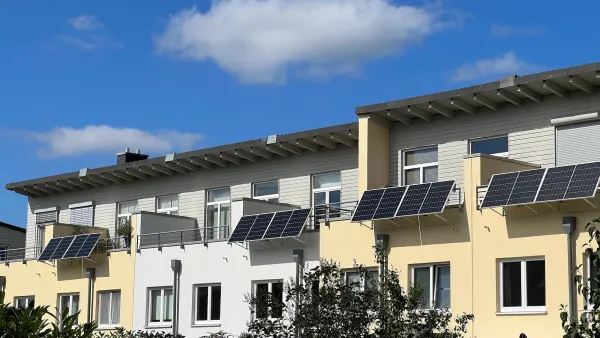
28 States and DC Could Legalize ‘Balcony Solar’
Plug-in solar panels, which are becoming popular across Europe, live in a regulatory gray area in the United States.
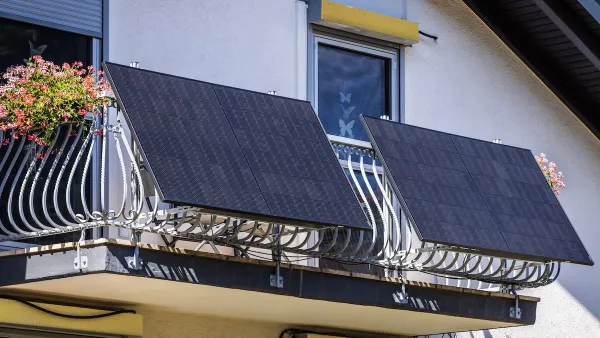
Bay Area Embraces ‘Balcony Solar’
Popular in Germany, wall- or balcony-mounted solar panels come at a lower cost and face fewer regulatory hurdles than rooftop solar, but their legal status in California is murky.
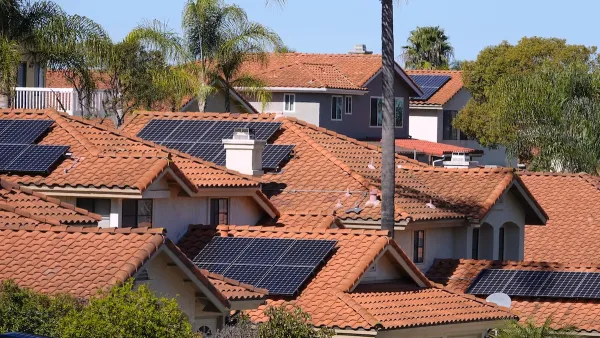
California Leads in Solar Rooftops
A combination of state and local incentives and building code mandates has helped California far outpace other states in residential rooftop solar permits.

Planetizen Federal Action Tracker
A weekly monitor of how Trump’s orders and actions are impacting planners and planning in America.

California plans to bury El Niño’s downpour
If the state plays its cards right, it may be able to store a billion acre-feet of El Niño’s water in aquifers.

Chicago breaks ground on $3 billion megadevelopment
The new neighborhood, titled Foundry Park, will one day host 3,700 residences.

California High-Speed Rail Authority CEO resigns after $600,000 scandal
Under Ian Choudri, the authority used taxpayer dollars to fund first class flights and trips to nightclubs.

Want to study the Missouri River? Soon, you may need unanimous approval from 10 states
Legislation would require 10 governors’ permission to study or build projects moving water outside the basin.

Desperate measures: Advocates weigh draining Lake Powell to fill Colorado River
Draining the reservoir could reduce evaporation losses by a couple hundred thousand acre-feet.

FREE Course: Walkable City 1: Why Walkability?
After describing his path towards focusing on walkability as the essence of good planning, Jeff Speck marches through his five principal reasons for making more walkable places.
Reinventing Malls: Planning Alchemy—Turning Gray Fields Into Gold
The course focuses on the opportunities and imperatives that shape reinvention of mall sites.

City of Rosemead
Rutgers University, Edward J. Bloustein School of Planning and Public Policy
One Hundred Miles
Hunter College, City University of New York (CUNY)
The Architects Foundation
University of Cincinnati Online
City of Cambridge
Montrose County
The Pocatello Development Authority