Remember President Obama's 2009 economic stimulus program? Add another completed project to the program's successes: the restoration of the multi-modal 1874 iconic Eads Bridge connecting St. Louis and East St. Louis, Ill. over the Mississippi River.



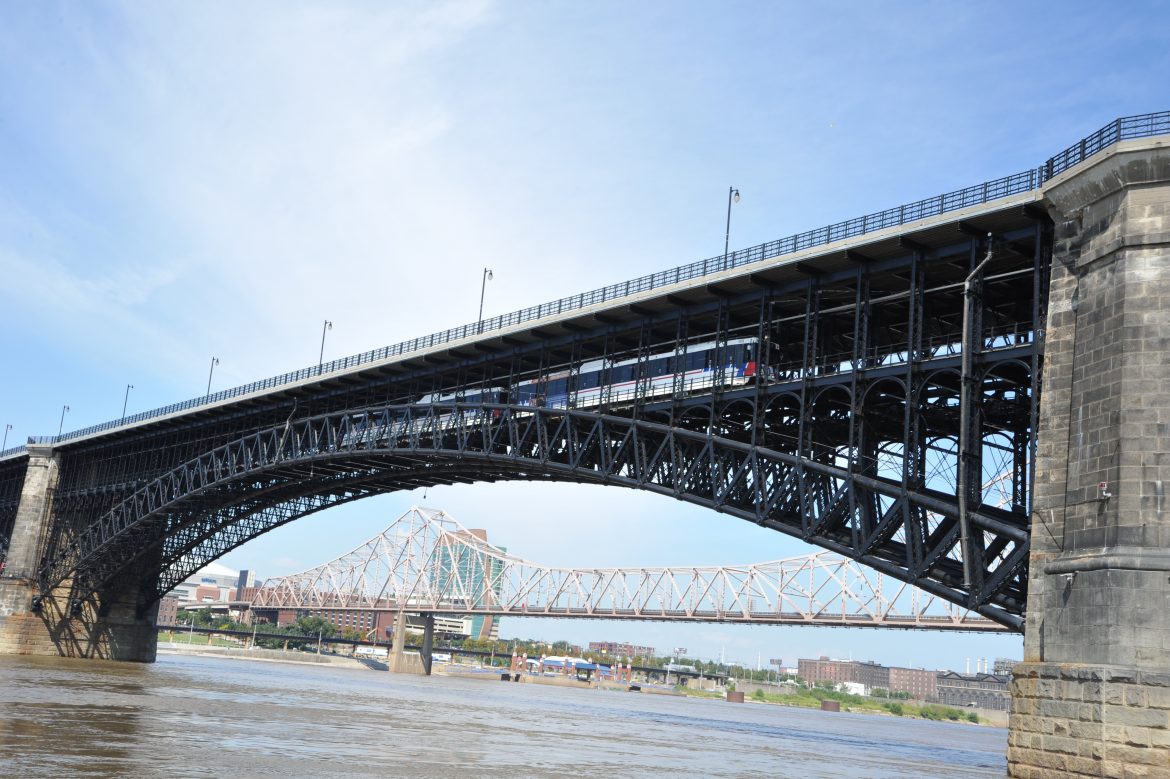
A celebration of the completion of the four-year, $48 million rehabilitation of the 142-year-old Eads Bridge, seen below with a St. Louis Metrolink light rail train running on the lower deck, occurred on October 7.
"The Eads Bridge, named for designer and builder James Eads, was the world's longest when built, the first using all steel for its arched spans, the first to exclusively cantilever supports, according to a Greatriverroad.com visitor's guide," reports AASHTO Journal.
Federal funds covered 91 percent of the project cost, said [Bi-State Development, which co-owns the bridge with the city of St. Louis], including $27 million coming from American Recovery and Reinvestment Act (ARRA) funds and $4.8 million from a federal grant to St. Louis. Local funds covered the non-federal portion.
"Eads Bridge is the world's first steel-truss bridge, and an engineering marvel," according to the St. Louis Cultural Resources Office. It was dedicated as as the city's first National Historic Landmark in 1964.
The October 7 celebration was also covered by the St. Louis Pubic Radio.
In addition to motor vehicles and 300 light rail trains daily, pedestrians and cyclists also cross on the top deck.
Also on Planetizen:
"With Mayoral Support—What's Next for Proposed MetroLink Extension in St. Louis," June 16, 2016.
Read the full story: St. Louis Bridge Gets Major Rehab, Facelift After 142 Years Aided by Stimulus Funds
$102 Million Brings Chicago-St. Louis High Speed Rail a Step Closer
A $102 million investment by Illinois along with federal funds from the Recovery Act will pay for double-tracking and a new rail bridge to enable 109 mph service on a key section of Amtrak's Chicago to St. Louis high speed rail corridor.

Faster Chicago to St. Louis Trains Likely to Increase Car Traffic
Next year, trains traveling at up to 110 mph will speed through grade crossings faster than the current trains traveling at up to 79 m.p.h, and motorists need to prepare for crossing gates that will stay down up to three times longer.

St. Louis Train Expansion Planning Receives Federal Funding
The Bi-State Development Agency received roughly $7.4 million for efforts to expand the city’s MetroLink train system.

Planetizen Federal Action Tracker
A weekly monitor of how Trump’s orders and actions are impacting planners and planning in America.

California plans to bury El Niño’s downpour
If the state plays its cards right, it may be able to store a billion acre-feet of El Niño’s water in aquifers.

Desperate measures: Advocates weigh draining Lake Powell to fill Colorado River
Draining the reservoir could reduce evaporation losses by a couple hundred thousand acre-feet.

In Texas, data centers are swallowing promised parkland
Residents who moved to Taylor, Texas for a rural community now have to contend with three data centers in their backyard.

How a Chicago-sized wind farm beat the odds and powered on
The project spanned five presidential administrations and a standoff with a U.S. military base.

MTA gives itself 30 days to transform pit into basketball court
The site has been under construction since 2022; the city originally estimated it would finish the court in 2024.

FREE Course: Walkable City 1: Why Walkability?
After describing his path towards focusing on walkability as the essence of good planning, Jeff Speck marches through his five principal reasons for making more walkable places.
Reinventing Malls: Planning Alchemy—Turning Gray Fields Into Gold
The course focuses on the opportunities and imperatives that shape reinvention of mall sites.

City of Rosemead
Rutgers University, Edward J. Bloustein School of Planning and Public Policy
One Hundred Miles
Hunter College, City University of New York (CUNY)
The Architects Foundation
University of Cincinnati Online
City of Cambridge
Montrose County
The Pocatello Development Authority