The most fantastic and fanciful projects ever proposed for New York City are collected and celebrated in a new book.


Carol Kino takes readers on a tour of Greg Goldin and Sam Lubell's new book, Never Built New York.
The book builds on the work of a similar Never Built book by Goldin and Lubell, focusing on Los Angeles, which culminated with a popular exhibition at the A+D Museum in 2013. This time, the duo mine New York's architectural history for ambitious projects scuttled by the "byzantine laws, battling egos and backroom deals" (as Kino puts it) that define the city's real estate.
Among the projects highlighted in Kino's coverage of the book: a much larger version of Gehry’s Guggenheim Bilbao, proposed in 2000 for the piers at the end of Wall Street; a dome over Manhattan, proposed by R. Buckminster Fuller in 1961; and the Hyperboloid, proposed by I.M. Pei in 1954 to replace Grand Central Station.
[The Wall Street Journal might be blocked by a paywall for some users.]
Read the full story: What the New York Skyline Could Have Been
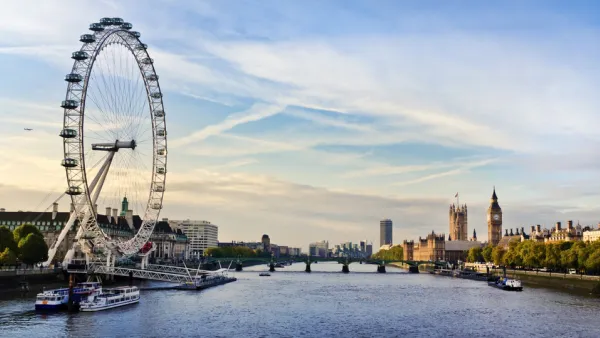
Staten Island Ferris Wheel Back From the Dead
With much of the infrastructure for the failed, 630-foot Ferris wheel project partially in place, investors are looking for ways to bring the New York Wheel back to life.
The New York Wheel Stops Spinning
Actually, the New York Wheel never started spinning, but now the project is permanently dead so it will never get the chance.
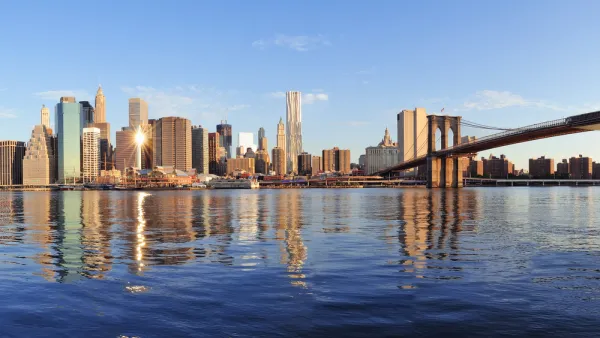
Never Built: The 1912 Plan to Expand Manhattan, Fill the East River
The blogosphere caught wind of a plan from 1912 that would have completely altered the geography of New York City as we know it. Make no little plans, indeed.

Planetizen Federal Action Tracker
A weekly monitor of how Trump’s orders and actions are impacting planners and planning in America.

Washington state to charge fee to drivers with fuel-efficient cars
Revenue from the fee will go towards supporting the state’s highways.

Illinois considers spending $1 billion in taxpayer money on data center
A quantum computing campus and data center are currently under construction in Chicago.

Mamdani unveils his ‘most ambitious bus lane project’ so far
The city has added two new bus lanes, which it expects to speed up tens of thousands of bus riders’ commutes.

New Jersey and New York suggest $10.3 billion budget for transit
Some of the budget is dedicated to replacing Manhattan's Midtown Bus Terminal.

States split over EPA’s proposal to drop greenhouse gas rules for power plants
The proposed rule drew over 165K comments, including from officials, health and environmental groups, and private citizens.

FREE Course: Walkable City 1: Why Walkability?
After describing his path towards focusing on walkability as the essence of good planning, Jeff Speck marches through his five principal reasons for making more walkable places.
Reinventing Malls: Planning Alchemy—Turning Gray Fields Into Gold
The course focuses on the opportunities and imperatives that shape reinvention of mall sites.

City of Charlotte
City of Rosemead
Rutgers University, Edward J. Bloustein School of Planning and Public Policy
University of Michigan School for Environment and Sustainability (SEAS)
Hunter College, City University of New York (CUNY)
The Architects Foundation
University District Partnership
City of Cambridge
The Pocatello Development Authority