Chicago's Englewood neighborhood recently saw the opening of a Whole Foods, Starbucks, and other retailers in a bit of a good news, for a neighborhood that's challenged by low employment and high violence.


At the corner of 63rd and Halsted, a new cluster of businesses are opening in a development called Englewood Square. Alexia Elejalde-Ruiz's story in the Chicago Tribune captures the significance of this development in talks with several of the nearby residents.
One of these residents, Sophelia Baptiste, will be employed in one of the 200 jobs the new commercial development. Baptiste remembered that her late brother, a victim of the city’s violence, had had a favorite Starbucks drink, a Caramel Macchiato.
Elejalde-Ruiz explains, "To Baptiste, who lives in Englewood, the unveiling of Starbucks, Whole Foods and several other retailers in the new Englewood Square shopping complex at 63rd and Halsted streets is a source of considerable pride during a bloody year in one of the city's poorest communities."
Elejalde-Ruiz also spoke to Perry Gunn, Executive Director of Teamwork Englewood, who commended the businesses for sending their executives to Englewood to speak directly with local stakeholders. Gunn went on to talk about the positive message sent by the businesses putting local faces in their stores. The story ends with a quote from Gunn talking about what these businesses mean to some Englewood residents. "Having the same amenities other communities enjoy makes the Englewood community feel respected."
Others in the neighborhood expressed greater skepticism about the wisdom of the developments, pointing out the disparity between upscale groceries at Whole Foods and the more modest prices at Aldi. But most, including the city's mayor, expressed their hope for Englewood Square's success.
Read the full story: Englewood hopes Starbucks, Whole Foods create 'ripple effect'
Whole Foods Moving into a Food Desert in Chicago's Englewood Neighborhood
Why would Whole Foods—a company colloquially known as "Whole Paycheck" and as a staple of wealthy neighborhoods—open an 18,000-square-foot location in one of the most impoverished parts of Chicago?
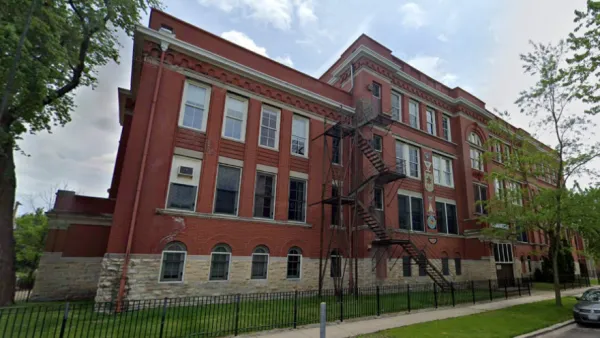
Historic Chicago School Building to Become Affordable Housing
The adaptive reuse project will create 50 income-restricted housing units and community amenities.
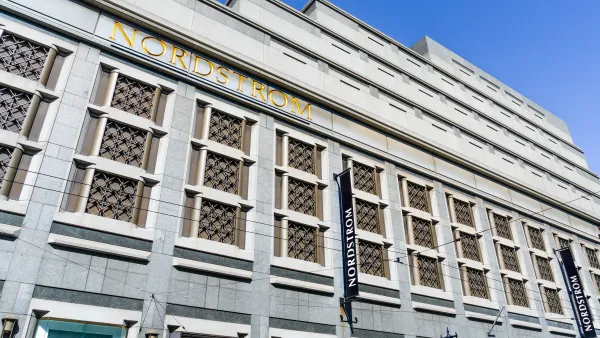
Recent Retail Closures in U.S. Cities Follow Trends Established Before the Pandemic
While some cling to debatable claims about higher crime rates as the cause for recent high-profile store closures in U.S. downtowns, the real reasons are more realistically extensions of the causes of the “retail apocalypse” from the before times.

Planetizen Federal Action Tracker
A weekly monitor of how Trump’s orders and actions are impacting planners and planning in America.

Washington state to charge fee to drivers with fuel-efficient cars
Revenue from the fee will go towards supporting the state’s highways.

Study reveals best places in the U.S. for cycling, walking
New research from Streetlight Data examines bicycle and pedestrian miles per capita in the 100 largest U.S. cities by population.

Mamdani unveils his ‘most ambitious bus lane project’ so far
The city has added two new bus lanes, which it expects to speed up tens of thousands of bus riders’ commutes.

New Jersey and New York suggest $10.3 billion budget for transit
Some of the budget is dedicated to replacing Manhattan's Midtown Bus Terminal.

States split over EPA’s proposal to drop greenhouse gas rules for power plants
The proposed rule drew over 165K comments, including from officials, health and environmental groups, and private citizens.

FREE Course: Walkable City 1: Why Walkability?
After describing his path towards focusing on walkability as the essence of good planning, Jeff Speck marches through his five principal reasons for making more walkable places.
Reinventing Malls: Planning Alchemy—Turning Gray Fields Into Gold
The course focuses on the opportunities and imperatives that shape reinvention of mall sites.

City of Charlotte
City of Rosemead
Rutgers University, Edward J. Bloustein School of Planning and Public Policy
University of Michigan School for Environment and Sustainability (SEAS)
Hunter College, City University of New York (CUNY)
The Architects Foundation
University District Partnership
City of Cambridge
The Pocatello Development Authority