Against all odds, both political parties agree on at least one thing: the merits of homeownership. But is buying a home really such a great investment, even for the well-off?


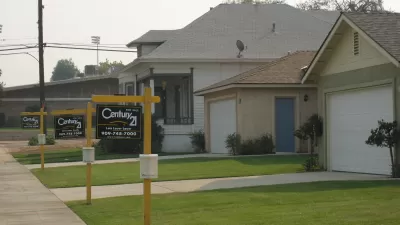
The received wisdom is that it's just better to own a place. And even after the shambles of 2008, that hasn't changed much. Emily Hamilton writes, "Even though the financial crisis revealed the risks that homeowners take on by making highly leveraged purchases, policymakers are still developing new programs to encourage home buying."
As the housing crisis made clear, low-income people shouldn't take the decision to buy lightly. "Joe Cortright recently pointed out that homeownership is a particularly risky bet for low-income people who may only have access to credit during housing market upswings, leaving them more likely to buy high and sell low."
Even for those in a stabler financial position, buying a home isn't necessarily the best investment. "Politicians across the political spectrum tout homeownership as key to a middle-class existence, but homeownership will make many buyers poorer in the long run compared to renting." Renters, after all, can theoretically invest that down payment into vehicles that pay greater long-term dividends. But it should be noted that this argument depends a great deal on where you buy.
Hamilton discusses the faults of online "buy-versus-rent" calculators that may be skewed to favor buying property. And she emphasizes another downside of buying: it reduces mobility in an economy that prizes it.
From the article: "Often, home ownership simply leads to higher levels of housing consumption rather than wealth-building. [...] But from a policy perspective, does it make sense to encourage people to save up for a poor investment, or would those resources be better spent on financial literacy programs?"
Read the full story: Urban[ism] Legend: A Home Is A Good Investment
Ultra-Competitive Housing Market Shows No Signs of Slowing
Home prices in the Puget Sound region continue to skyrocket as buyers engage in intense bidding wars and demand continues to outpace supply.
Housing Affordability Crisis Spreading to More Cities
Cities like Spokane, Washington courted new residents and businesses during the pandemic. Now, they're starting to wonder if it was worth it.
Homeownership an Uphill Battle for Black New Yorkers
Black home buyers face an array of challenges when trying to buy homes, leading to a widening gap between Black and white homeowners.

Planetizen Federal Action Tracker
A weekly monitor of how Trump’s orders and actions are impacting planners and planning in America.

Washington state to charge fee to drivers with fuel-efficient cars
Revenue from the fee will go towards supporting the state’s highways.

Illinois considers spending $1 billion in taxpayer money on data center
A quantum computing campus and data center are currently under construction in Chicago.

Senate passes bill overhauling permitting
The bill still needs to pass the House.

Did data centers change how voters cast their ballots?
Texas, Ohio, and Georgia all flipped party control. But in rural counties, the effect of local data centers was mixed.

Amtrak invests in eight new Airo trainsets
The new trainsets will begin serving passengers in 2031.

FREE Course: Walkable City 1: Why Walkability?
After describing his path towards focusing on walkability as the essence of good planning, Jeff Speck marches through his five principal reasons for making more walkable places.
Reinventing Malls: Planning Alchemy—Turning Gray Fields Into Gold
The course focuses on the opportunities and imperatives that shape reinvention of mall sites.

City of Charlotte
City of Rosemead
Rutgers University, Edward J. Bloustein School of Planning and Public Policy
University of Michigan School for Environment and Sustainability (SEAS)
Hunter College, City University of New York (CUNY)
The Architects Foundation
University District Partnership