The plight of laid-off laborers who had been repaving a New Jersey bridge illustrates that people suffer as well as infrastructure and mobility when transportation funding bills fail to pass.


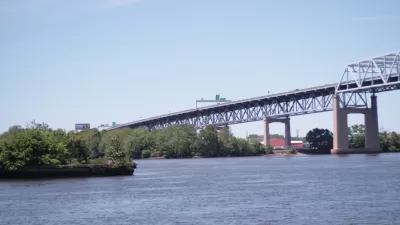
Due to a 'state of emergency' declared June 30 by Gov. Chris Christie that shut down most state-funded road projects, the Garden State may be suffering more than any other state in terms of its ability to keep roads in good repair. But it's not just the roads that are suffering.
"The workers have been laid off since July 8, when Governor Christie ordered most state-financed construction projects to close because the Transportation Trust Fund is broke," reports Christopher Maag for The Record. "When Christie issued his executive order [PDF], he told the New Jersey Department of Transportation to expect the closure to last at least seven days."
Then, last week, State Senate President Steve Sweeney told the editorial board at The Record that he didn’t expect a fix until after the November election.
Labor unions are organizing the protests. The American Road & Transportation Builders Association is also protesting the shutdown. Both groups see the solution as increasing the gas tax. According to the ARTBA analysis [PDF], 1,700 construction workers will be displaced by the shutdown. "Over time, the reduction in [labor] demand could impact an additional 1,500 non-construction jobs."
Political impasse
As posted earlier, Gov. Christie wants the 23-cents gas tax increase to be accompanied by a one cent reduction in the state sales tax, which "blows a $2 billion hole in the budget," stated Sen. Raymond Lesniak (D-Union).
The Senate agreed to a tax reduction package costing $870 million. Both are examples of tax shifts, which theoretically shouldn't be required to increase the gas tax, particularly in New Jersey, which has the second lowest rate (14.5-cents per gallon) in the country, and hasn't been increased since 1988.
New Jersey Transportation Fund is dead broke
"Today the trust fund owes $30 billion in principal and interest, according to the Transportation Trust Fund Authority, which runs it," reports Maag. "Making payments on that debt now consumes every penny of revenue from the gas tax and other fees, making it impossible to finance new construction projects." [See "Road to Repair"].
The problem, transportation expert Martin E. Robins said, is that elected officials of both parties tried to meet voters’ conflicting demands. On one hand, everybody wants a safe transportation network that is well-maintained and gridlock-free. Few people want to pay for it, however. Polls by the Eagleton Institute of Politics at Rutgers University over the last year and a half show a solid majority of New Jersey residents oppose a gas tax increase.
Maag writes the fund "has been in crisis since at least 2003." Robins, "founding director of the Alan M. Voorhees Transportation Center at Rutgers University," gives a detailed explanation of all that went wrong with the trust fund over the terms of several governors. He "first warned of the looming crisis in a report published in June 2000."
Hat tip to The AASHTO Daily Transportation Update
FULL STORY: Construction workers protesting stalemate on N.J. transportation funding

Landmark Agreement Reached to Increase New Jersey Gas Tax by 23 Cents
A day after a fatal NJ Transit train crash at the Hoboken Terminal, Republican Gov. Chris Christie and Democratic leaders of the legislature announced the agreement to raise the tax by 159 percent; the first increase to the *14.5-cent tax since 1990.
New Jersey Transit Board Hasn't Met in Over 100 Days
There's a major transportation showdown underway in New Jersey, but that doesn't excuse the New Jersey Transit Board from holding public meetings.
Road Projects Shut Down in New Jersey As Funds Run Out
A bill to replenish the state transportation trust fund by increasing the gas tax 23 cents per gallon stalled in the Senate because it would also cut $2 billion annually to the state's general fund.

The state-sanctioned urbicide of Austin
People don’t kill cities. Freeways do.

US to reduce Colorado River water deliveries to Mexico
A new Colorado Treaty amendment reduces Mexico’s Colorado River water allocation by 250,000 acre feet.

New Jersey’s second-largest city bans standalone data centers
Jersey City will continue to allow co-location facilities, such as those meant for research institutions that store their own data.

Amtrak not solely to blame for New Jersey commuter rail's unreliability, report finds
A new study from the Garden State Initiative found that NJ Transit’s budget grew 20% across a 4 year period, but reliability declined significantly over the same period.

EPA erases limits on planet-warming pollution from power plants
Under Monday’s plan, power plants would still have some limits on how much mercury, arsenic and other contaminants they can emit.

Phoenix announces new on-demand transit service, more frequent RAPID buses
Both new services will launch in October, and are part of Phoenix's Project Effective Access Solutions for Easing Congestion.

FREE Course: Walkable City 1: Why Walkability?
After describing his path towards focusing on walkability as the essence of good planning, Jeff Speck marches through his five principal reasons for making more walkable places.
Reinventing Malls: Planning Alchemy—Turning Gray Fields Into Gold
The course focuses on the opportunities and imperatives that shape reinvention of mall sites.

Eagle County Government
Harvard University Graduate School of Design
Nashville Planning Department
The Architects Foundation
University of Cincinnati Online
The Pocatello Development Authority
The Urban Renewal Agency of the City of Pocatello
Journal of the American Planning Association