2015 was basically the Michael Phelps of climate change, according to a new report.


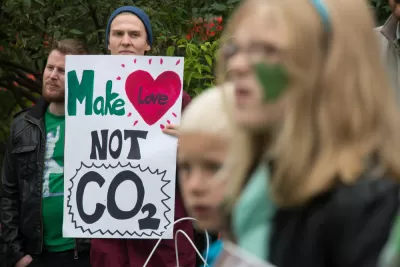
"Last year officially surpassed 2014 as the warmest year ever noted on record," according to an article by Madeleine Thomas. But that's not the only climate-related record that fell in 2015. "Rising oceans, accumulating atmospheric greenhouse gasses, and escalating temperatures on both sea and land all reached new record highs in 2015," adds Thomas
That documentation of these new milestones are presented in the "State of the Climate" report, by the American Meteorological Society and the National Oceanic and Atmospheric Administration’s National Centers for Environmental Information, released on August 2, 2016.
The report is described as an "annual physical" for the planet, with findings generated by 450 scientists from 62 countries. Thomas summarizes some of the most significant milestones revealed by the report in the article. For an example of the alarms sounded by the report, Thomas writes that in 2015, "annual average atmospheric C02 levels passed 400 ppm for the first time in more than three million years."
Read the full story: No Surprise Here: 2015 Was the Warmest Year Yet
FTA Kills ‘Social Cost of Carbon’ in Transit Grant Criteria
The Capital Investments Grant program will no longer factor in the future impacts of carbon emissions.

Driving Equity and Clean Air: California Invests in Greener School Transportation
California has awarded $500 million to fund 1,000 zero-emission school buses and chargers for educational agencies as part of its effort to reduce pollution, improve student health, and accelerate the transition to clean transportation.
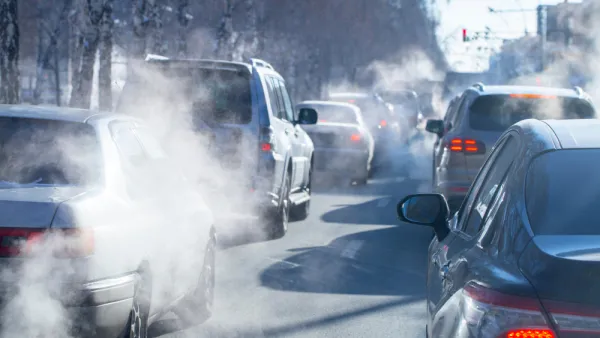
USDOT Repeals Emissions Monitoring Rule
A Biden-era regulation required states to report and plan to reduce transportation-related emissions.

Planetizen Federal Action Tracker
A weekly monitor of how Trump’s orders and actions are impacting planners and planning in America.

California plans to bury El Niño’s downpour
If the state plays its cards right, it may be able to store a billion acre-feet of El Niño’s water in aquifers.

Desperate measures: Advocates weigh draining Lake Powell to fill Colorado River
Draining the reservoir could reduce evaporation losses by a couple hundred thousand acre-feet.

Chicago voters approve permanent festival grounds, penalty for vacant property owners
Currently, major summer and fall festivals take over public parks for weeks at a time, drawing criticism from nearby residents

NYC votes to cut outdoor dining red tape, speed up permitting
New York City also voted to allow the Department of Transportation to begin work on urgent projects before notifying elected officials.

California appears to reject Prop. 45
The proposition would have expanded the projects that qualify for a streamlined environmental review, effectively paring down the California Environmental Quality Act.

FREE Course: Walkable City 1: Why Walkability?
After describing his path towards focusing on walkability as the essence of good planning, Jeff Speck marches through his five principal reasons for making more walkable places.
Reinventing Malls: Planning Alchemy—Turning Gray Fields Into Gold
The course focuses on the opportunities and imperatives that shape reinvention of mall sites.

City of Rosemead
Rutgers University, Edward J. Bloustein School of Planning and Public Policy
One Hundred Miles
Hunter College, City University of New York (CUNY)
The Architects Foundation
University of Cincinnati Online
City of Cambridge
Montrose County
The Pocatello Development Authority