A project dogged by controversy and opposition took another blow this week, this time from a federal judge. The ongoing safety and operations issue of the Metrorail system played a role in the ruling.


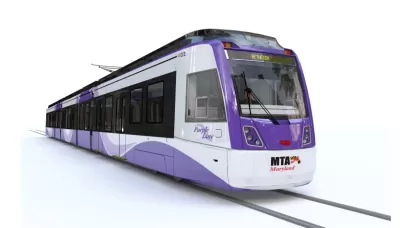
The Associated Press reports that a federal judge is requiring the state of Maryland to re-do its study of anticipated ridership for the Purple Line, a 16.2-mile line planned for the Metrorail system.
In a separate article, Kristi King explains the reasing behind the decision "U.S. District Judge Richard J. Leon said Maryland must do another study projecting anticipated Purple Line ridership [pdf] that takes into account the potential impact of declining Metrorail ridership and safety issues."
Construction on the Purple Line was scheduled to begin in 2016, but the court ruling, and the study process, could set that target back by six months. The court ruling follows years of local opposition, but last Planetizen heard from the project, in April 2016, there was positive news about a contract to build and operate the line.
Read the full story: Federal judge orders further study of Purple Line, delays start
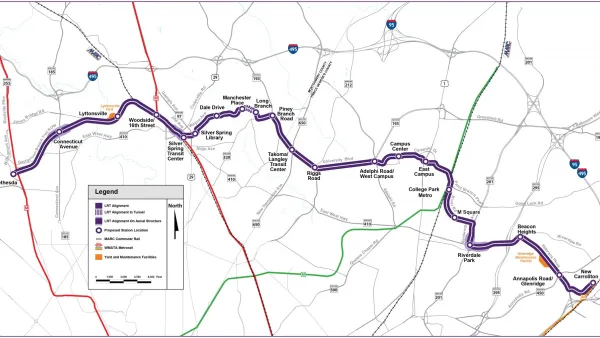
Court Ruling Could Be a Final Setback for Maryland Purple Line Extension
A recent ruling by a U.S. district court could be a deathblow for the 16-mile Purple Line extension into Maryland, as well as for transit planning in general.
Purple Line Light Rail Gets Critical Go-Ahead in Maryland
The Purple Line light rail route will connect Bethesda and New Carrollton in Maryland.
DC Metro Is Betting on Buses
The agency plans to significantly expand bus service, which can be added faster and at a lower cost than rail projects.

Planetizen Federal Action Tracker
A weekly monitor of how Trump’s orders and actions are impacting planners and planning in America.

California plans to bury El Niño’s downpour
If the state plays its cards right, it may be able to store a billion acre-feet of El Niño’s water in aquifers.

Desperate measures: Advocates weigh draining Lake Powell to fill Colorado River
Draining the reservoir could reduce evaporation losses by a couple hundred thousand acre-feet.

Mamdani’s pied-à-terre tax survives legal challenge
A panel of judges found that the plaintiffs failed to demonstrate injury as a result of New York City's implementation of the tax.

Eastern Nebraska is running out of electricity
Data centers and electrification are straining eastern Nebraska’s grid, throttling economic development.

Seattle passes record-breaking transit services expansion
Proposition 1 will double the city’s transit tax to add 95,000 more bus trips and preserve 180,000 bus trips annually.

FREE Course: Walkable City 1: Why Walkability?
After describing his path towards focusing on walkability as the essence of good planning, Jeff Speck marches through his five principal reasons for making more walkable places.
Reinventing Malls: Planning Alchemy—Turning Gray Fields Into Gold
The course focuses on the opportunities and imperatives that shape reinvention of mall sites.

City of Rosemead
Rutgers University, Edward J. Bloustein School of Planning and Public Policy
One Hundred Miles
Hunter College, City University of New York (CUNY)
The Architects Foundation
University of Cincinnati Online
City of Cambridge
Montrose County
The Pocatello Development Authority