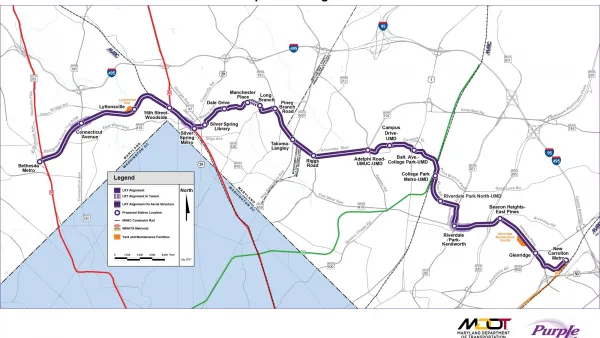
In exchange for a promise from a country club not to oppose the planned Purple Line, the Maryland Transit Administration has agreed to move tracks, build sound walls, and attend regular meetings. Residents aren't happy about the special treatment.


"Maryland officials have signed a legal agreement with the Columbia Country Club promising to shift the Purple Line’s proposed course to better protect the club’s Chevy Chase golf course — one of several concessions setting the country club apart from hundreds of other property owners along the route," reports Katherine Shaver.
"Community concerns have prompted other changes to the Purple Line’s design, state officials have said, including a smaller train storage yard farther from homes in the Lyttonsville community of Silver Spring and improved pedestrian and bicycle access," she notes. "But other private property owners do not have legally binding agreements or guarantees of regular meetings with state transit officials, like those granted to the country club."
“I think it’s great the country club can secure these concessions and promises, but what about the rest of us without the same clout or resources?” said Phil MacWilliams, president of the Coquelin Run Citizens Association.
Read the full story: Purple Line route changed to spare part of Columbia Country Club golf course
Maryland's Purple Line Gets the Green Light Again
The public-private partnership behind the Purple Line light rail project in Maryland fell apart in September, and has this past week been revived.
Purple Line Construction Halts in Maryland as Contractor Woes Deepen
Purple Line Transit Partners, the contractors managing construction of the beleaguered Purple Line in Maryland, have begun to walk off the job as a dispute about cost overruns brings the project to a screeching halt.

Preserving Affordable Housing Along Maryland Light Rail Line
A new plan lays out strategies to keep housing affordable for low- and moderate-income residents along the corridor of Maryland’s new Purple Line.

Planetizen Federal Action Tracker
A weekly monitor of how Trump’s orders and actions are impacting planners and planning in America.

California plans to bury El Niño’s downpour
If the state plays its cards right, it may be able to store a billion acre-feet of El Niño’s water in aquifers.

Desperate measures: Advocates weigh draining Lake Powell to fill Colorado River
Draining the reservoir could reduce evaporation losses by a couple hundred thousand acre-feet.

Mamdani’s pied-à-terre tax survives legal challenge
A panel of judges found that the plaintiffs failed to demonstrate injury as a result of New York City's implementation of the tax.

Eastern Nebraska is running out of electricity
Data centers and electrification are straining eastern Nebraska’s grid, throttling economic development.

Seattle passes record-breaking transit services expansion
Proposition 1 will double the city’s transit tax to add 95,000 more bus trips and preserve 180,000 bus trips annually.

FREE Course: Walkable City 1: Why Walkability?
After describing his path towards focusing on walkability as the essence of good planning, Jeff Speck marches through his five principal reasons for making more walkable places.
Reinventing Malls: Planning Alchemy—Turning Gray Fields Into Gold
The course focuses on the opportunities and imperatives that shape reinvention of mall sites.

City of Rosemead
Rutgers University, Edward J. Bloustein School of Planning and Public Policy
One Hundred Miles
University of Michigan School for Environment and Sustainability (SEAS)
Hunter College, City University of New York (CUNY)
The Architects Foundation
City of Cambridge
Montrose County
The Pocatello Development Authority