The controversy over a protected bike lane along Central Parkway in Cincinnati continues. The latest grist for the mill comes from a report finding that crashes increased in the first complete year of the lane's operation.


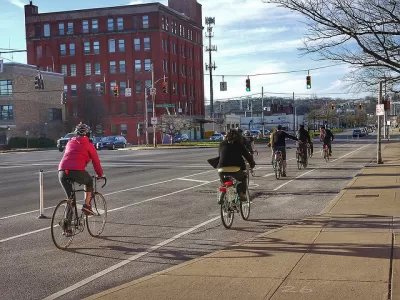
Chris Wetterich reports from Cincinnati: "A new city study of crash data found that the number of car crashes on Central Parkway experienced an uptick after the city installed a controversial protected bikeway along the road in 2014 but has fallen in recent months."
"The total number of crashes in 2012 along the road from Liberty to Linn streets was 57 compared with 62 in 2015," according to Wetterich, though for "the first four months of 2016, the number of crashes – 14 – has decreased compared to the same periods in 2015 and 2012, when there were 19 and 17, respectively."
The Central Parkway bike lane project inspired controversy, right up until it opened, as Planetizen documented in October and April of 2014. According to Wetterich, the controversy continues, though a majority of the Cincinnati City Council wants to keep the bike lanes.
Read the full story: Did car crashes on Central Parkway rise with bikeway installation?

Cincinnati's First Cycle Track Overcame Controversy, Now Open for Bikers
The Central Parkway Cycle Track is open in Cincinnati, having overcome the controversies that almost led to the project's demise.
Moment of Truth for Cincinnati's Central Parkway
The Cincinnati City Council might vote to rescind an agreement with the Ohio Department of Transportation to complete a protected bike lane from Clifton to downtown along the Central Parkway.
Op-ed: True bike safety requires more than the 'Dutch reach'
Making roads safe for all users takes policy and cultural changes that go beyond small behavioral interventions.

Planetizen Federal Action Tracker
A weekly monitor of how Trump’s orders and actions are impacting planners and planning in America.

California plans to bury El Niño’s downpour
If the state plays its cards right, it may be able to store a billion acre-feet of El Niño’s water in aquifers.

Desperate measures: Advocates weigh draining Lake Powell to fill Colorado River
Draining the reservoir could reduce evaporation losses by a couple hundred thousand acre-feet.

Metra may invest $9.1 billion in regional rail
The agency released a draft of a study examining potential ways to offer more frequent train service.

California city breaks ground on transit connector
The project includes three mobility hubs and a pedestrian bridge.

After public outcry, Massachusetts city releases housing development tracker
Cambridge’s tracker currently shows 250 housing projects in various stages of development.

FREE Course: Walkable City 1: Why Walkability?
After describing his path towards focusing on walkability as the essence of good planning, Jeff Speck marches through his five principal reasons for making more walkable places.
Reinventing Malls: Planning Alchemy—Turning Gray Fields Into Gold
The course focuses on the opportunities and imperatives that shape reinvention of mall sites.

City of Rosemead
Rutgers University, Edward J. Bloustein School of Planning and Public Policy
One Hundred Miles
Hunter College, City University of New York (CUNY)
The Architects Foundation
University of Cincinnati Online
City of Cambridge
Montrose County
The Pocatello Development Authority