A new law with the support of the mayor and an initial approval by the D.C. council will make it easier for bicyclists and pedestrians to collect insurance after a crash with a motor vehicle.


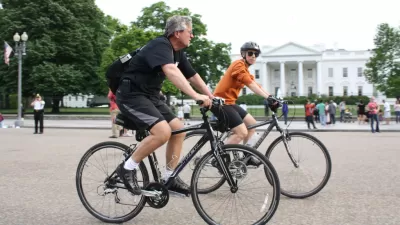
Andrew Giambrone reports on a victory for pedestrian and bike advocates, after Washington, D.C. has made progress toward adopting the Motor Vehicle Collision Recovery Act [pdf] into law.
The Washington, D.C. Council voted unanimously to upvote the act, with a second vote expected in September. Existing D.C. law allows for bicyclists and pedestrians to collect insurance after a collision only if the driver in the crash was 100 percent at fault.
As a separate article by Luz Lazo on the new legislation explains, the new law gives "[b]icyclists and pedestrians in the District could soon have a greater chance of recouping a share of medical bills and other costs after a crash."
"The legislation would give bicyclists the right to argue fault in shades of gray with insurance companies and juries, giving them a greater shot at collecting damages," adds Lazo.
Both Lazo and Giambrione note that insurance groups like AAA Mid-Atlantic oppose the new law.
An article by Eillie Anzilotti earlier in July surveyed the places where contributory negligence was still the law of the land, including Washington, D.C., Virginia, North Carolina, and Alabama.
FULL STORY: D.C. Council Unanimously Passes Bike and Pedestrian Safety Bill Without Debate

'Vision Zero' Requires More Data in Washington, D.C.
Advocates say traffic safety data collection practices in Washington, D.C. don't meet national standards. They also say it will be hard for the District to meet its vision zero goal by 2024 if the problem persists.

Proposed Bill Would Direct Funds to Road Safety
The Sarah Debbink Langenkamp Active Transportation Safety Act was spurred by the death of a U.S. diplomat who was killed on her bicycle.

Data Shows Chicago Speed Cameras Reduce Speeding, Crashes
Countering claims made by the Chicago Tribune that automated enforcement doesn’t improve safety, Streetsblog Chicago lays out the data showing how traffic safety fared in camera zones.

Planetizen Federal Action Tracker
A weekly monitor of how Trump’s orders and actions are impacting planners and planning in America.

The state-sanctioned urbicide of Austin
People don’t kill cities. Freeways do.

US to reduce Colorado River water deliveries to Mexico
A new Colorado Treaty amendment reduces Mexico’s Colorado River water allocation by 250,000 acre feet.

5 New England states march closer to 800 megawatt wind energy project
Securing federal approval for the project may be complicated under the Trump administration, which has historically been hostile towards domestic wind power.

Baltimore to break ground on $50 million Transit Priority Project
The project will bring faster bus trips, safer streets and better bike connections to Baltimore.

Airbnb launches $250 million 'last-dollar financing' housing accelerator, makes first investment in Austin
The company will put $6.4 million towards affordable housing development in Texas’ capital.

FREE Course: Walkable City 1: Why Walkability?
After describing his path towards focusing on walkability as the essence of good planning, Jeff Speck marches through his five principal reasons for making more walkable places.
Reinventing Malls: Planning Alchemy—Turning Gray Fields Into Gold
The course focuses on the opportunities and imperatives that shape reinvention of mall sites.

Eagle County Government
Harvard University Graduate School of Design
Nashville Planning Department
The Architects Foundation
University of Cincinnati Online
The Pocatello Development Authority
The Urban Renewal Agency of the City of Pocatello
Journal of the American Planning Association