A city famous for tall palm trees wants to find some shade.



William Yardley reports on an ongoing planning effort in Phoenix to cultivate a tree canopy that would cover 25 percent of the city by 2030. Currently the city's canopy covers less than half that amount.
"Yet with a new emphasis on downtown development and walkable neighborhoods, as well as increasing concerns about heat on human health (forecasts show that climate change will make things even hotter here), Phoenix is actively seeking more shade," writes Yardley.
The article focuses on the work and ideas of Richard Adkins , who is leading the planning effort with the support of the city. Adkins's methodology "uses a formula developed by the United States Forest Service and arborist groups that factors in how much carbon a tree stores, how much electricity it saves, how much it reduces stormwater and the aesthetic value it offers."
Read the full story: In Phoenix, an ambitious plan aims to cover 25% of the metropolis with tree shade
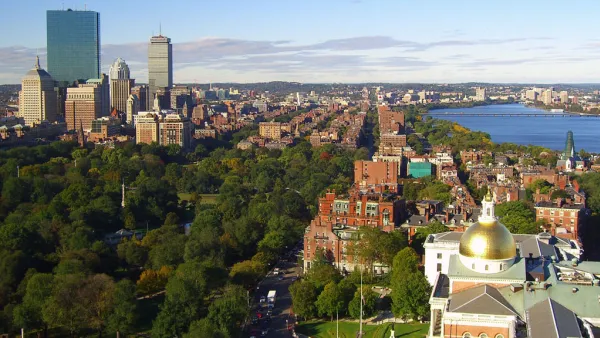
Boston Launches a 20-Year Urban Forestry Plan
The forthcoming Boston Urban Forestry Plan is expected to support communities that have been disproportionately exposed to environmental stressors.
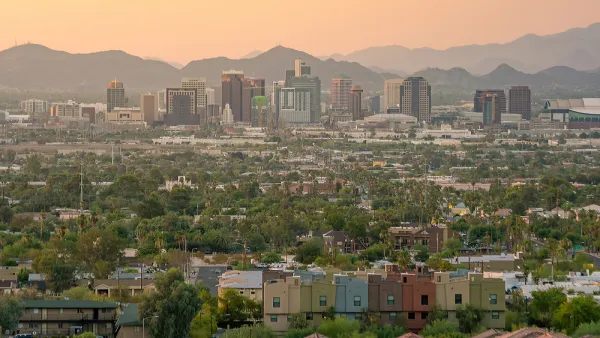
When Affordable for the County Isn't Affordable for the Neighborhood
A critical question arises in response to an affordable housing project proposed in Phoenix: When measuring a project's affordability, does the larger county's median income matter when some neighborhoods are struggling well beyond that measure?
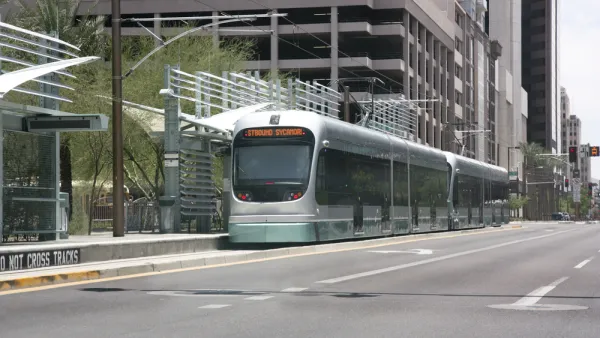
Court: Phoenix Transit Spending Initiative Stays on the Ballot
The whole idea of public transit will be up for reconsideration in Phoenix on August 27.

Desperate measures: Advocates weigh draining Lake Powell to fill Colorado River
Draining the reservoir could reduce evaporation losses by a couple hundred thousand acre-feet.

Eastern Nebraska is running out of electricity
Data centers and electrification are straining eastern Nebraska’s grid, throttling economic development.

Malls are becoming the midtowns of the future
Mall and office park redevelopments are a generational opportunity to create new nodes of urbanity.

NYC breaks ground on anti-flooding infrastructure project
New York City's new system will reduce stormwater flows to local sewers by 90%.

One Kentucky town’s secret to affordable housing
The Smoketown Community Land Trust has already built seven affordable homes for community members.

Houston gains petal-shaped cooling infrastructure to make streets more ‘delightful’
The city has installed the pavilions along 15 blocks in Houston.

FREE Course: Walkable City 1: Why Walkability?
After describing his path towards focusing on walkability as the essence of good planning, Jeff Speck marches through his five principal reasons for making more walkable places.
Reinventing Malls: Planning Alchemy—Turning Gray Fields Into Gold
The course focuses on the opportunities and imperatives that shape reinvention of mall sites.

City of Rosemead
Rutgers University, Edward J. Bloustein School of Planning and Public Policy
One Hundred Miles
University of Michigan School for Environment and Sustainability (SEAS)
Hunter College, City University of New York (CUNY)
The Architects Foundation
City of Cambridge
Montrose County
The Pocatello Development Authority