A May 7 crash of a Model S Tesla in Florida may have outsized implications for the future of driverless technology. The details of the single-fatality crash were made public in a June 30 blog by Tesla though they were reported immediately to NHTSA.


Self-driving or 'automated vehicle safety' technology holds enormous implications for reducing traffic crashes, and thus fatalities and injuries. An estimated 35,200 people lost their lives year on American roads last year, up 7.7 percent from 2014.
"Ninety-four percent of crashes can be tied back to a human choice or error, so we know we need to focus our efforts on improving human behavior while promoting vehicle technology that not only protects people in crashes, but helps prevent crashes in the first place," said National Highway Traffic Safety Administration Administrator Dr. Mark Rosekind in a July 1 press release. [Italics added.]
Details of the May 7 crash were made available by the National Highway Traffic Safety Administration (NHTSA).
"In a statement, [NHTSA] said preliminary reports indicated that the crash occurred when a tractor-trailer made a left turn in front of the Tesla, and the car failed to apply the brakes," reported Neal E. Boudette and Bill Vlasic for The New York Times on June 30.
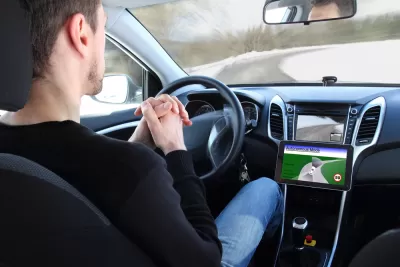
It is the first known fatal accident involving a vehicle being driven by itself by means of sophisticated computer software, sensors, cameras and radar.
The Silicon Valley-based electric car company's driverless technology is known as Autopilot. "Neither Autopilot nor the driver noticed the white side of the tractor trailer against a brightly lit sky, so the brake was not applied," Tesla states in their June 30 blog. However, that would not account for the failure of the radar to spot the trailer.
A Tesla equipped with Autopilot makes the Model S a "semi-autonomous" car, according to Gear Patrol staff writer Andrew Connor, as opposed to the fully autonomous technology that Google and Uber are working towards. Specifically, Tesla Autopilot is a "Level 2" technology, adds Connor, while Volvo Intellisafe Autopilot is Level 3, and Google Cars Level 4.
"NHTSA defines vehicle automation as having five levels," according to their May 2013 press release. Their table below is similar, but not identical to the one used by Connor.
- No-Automation (Level 0): The driver is in complete and sole control of the primary vehicle controls – brake, steering, throttle, and motive power – at all times.
- Function-specific Automation (Level 1): Automation at this level involves one or more specific control functions. Examples include electronic stability control or pre-charged brakes, where the vehicle automatically assists with braking to enable the driver to regain control of the vehicle or stop faster than possible by acting alone.
- Combined Function Automation (Level 2): This level involves automation of at least two primary control functions designed to work in unison to relieve the driver of control of those functions. An example of combined functions enabling a Level 2 system is adaptive cruise control in combination with lane centering.
- Limited Self-Driving Automation (Level 3): Vehicles at this level of automation enable the driver to cede full control of all safety-critical functions under certain traffic or environmental conditions and in those conditions to rely heavily on the vehicle to monitor for changes in those conditions requiring transition back to driver control. The driver is expected to be available for occasional control, but with sufficiently comfortable transition time. The Google car is an example of limited self-driving automation.
- Full Self-Driving Automation (Level 4): The vehicle is designed to perform all safety-critical driving functions and monitor roadway conditions for an entire trip. Such a design anticipates that the driver will provide destination or navigation input, but is not expected to be available for control at any time during the trip. This includes both occupied and unoccupied vehicles.
According to Tesla's Autopilot software description, "Tesla requires drivers to remain engaged and aware when Autosteer is enabled. Drivers must keep their hands on the steering wheel." It adds that it warns drivers about side collisions, not in front of them, which is what occurred on May 7. However, on the company's homepage, it states that Autopilot "helps avoid collisions from the front and sides."
Tracey Lien, Bay Area-based technology reporter for the Los Angeles Times, explains the different paths taken by Google and Tesla.
The divergent approaches reflect companies with different goals and business strategies. Tesla’s rapid-fire approach is in line with its image as a small but significant auto industry disruptor, while Google — a tech company from whom no one expects auto products — has the luxury of time.
The crash hasn't deterred Tesla or their devoted clientele using Autopilot who "view themselves as part of the test process for the autopilot feature – which the Palo Alto company describes as still being in beta mode," write Natalie Kitroeff and Samantha Masunaga for the Los Angeles Times.
A prescient June 24 Planetizen post, five days before the details of the May 7 crash were made public, lists five principles made by the National Association of City Transportation Officials (NACTO) to make autonomous vehicles urban-friendly. The first bears repeating here:
- Plan for fully automated vehicles, not half-measures: Going halfway with partially automated vehicles, instead of fully automated, would require drivers to take over if the vehicle encounters a dangerous situation. In practice, such vehicles have been shown to encourage unsafe driving behavior, with drivers reading more, texting more, and generally being inattentive while the vehicle is in motion.
Read NACTO’s full policy statement on automated vehicles (PDF).
Read the full story: Will First Fatality Involving Self-Driving Cars Affect their Development?

The Dilemma of Autonomous Vehicle Testing
Autonomous vehicles hold the potential to greatly reduce auto crashes. Advocates want them on the road as early as possible to reduce fatalities. Skeptics worry that the public will be guinea pigs during the testing—case in point: Elaine Herzberg.
Tesla Fatal Crash and Battery Fire Under Investigation
Wei Huang, a 38-year-old Apple engineer, died after his Tesla Model X collided with a highway barrier on a Bay Area highway interchange on March 23. NTSB wants to know if it was operating on Autopilot. It took 5 hours to reopen the freeway.

Failure of Automated Driving Technology Blamed for First Pedestrian Fatality
Experts who watched the videos taken by onboard cameras equipped in the Volvo SUV that hit Elaine Herzberg determined that Uber's automated driving system failed to perform adequately. The crash points to a need for regulations.

Planetizen Federal Action Tracker
A weekly monitor of how Trump’s orders and actions are impacting planners and planning in America.

Amtrak, CN end decades-long dispute with eight-year agreement
The new operating agreement establishes an updated framework for the companies to work together, including processes to resolve disputes.

Northwest rail fans eager for Sept. 30 debut of Amtrak’s Airo fleet
Get ready for that new train smell and more seats. But they won’t go faster or run more frequently on the Cascades route in Washington and Oregon.

Brightline Florida expected to file for bankruptcy this week
The transit agency is over $5 billion in debt.

Atlanta City Council unanimously backs $3.5 billion Beltline light rail project
The resolution was drafted after Atlanta Mayor Andre Dickens pulled support for the Atlanta Streetcar extension last year.

SEPTA to bring nearby frequent transit to over 1 million new riders as part of decade-long plan
The agency's Accelerate plan will also bring frequent transit to twice the amount of jobs that are currently located near it.

FREE Course: Walkable City 1: Why Walkability?
After describing his path towards focusing on walkability as the essence of good planning, Jeff Speck marches through his five principal reasons for making more walkable places.
Reinventing Malls: Planning Alchemy—Turning Gray Fields Into Gold
The course focuses on the opportunities and imperatives that shape reinvention of mall sites.

City of Thousand Oaks
City of Wisconsin Rapids
Harvard University Graduate School of Design
The Architects Foundation
University of Cincinnati Online
The Pocatello Development Authority
The Urban Renewal Agency of the City of Pocatello