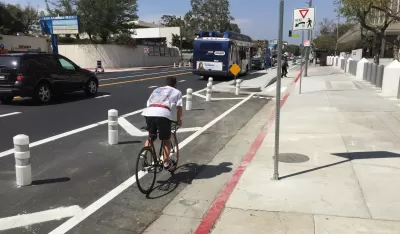
The traffic signals are part of the Los Angeles Street 'full-featured' protected bike lane that also includes transit stop islands and two-stage turn queue boxes. Ribbon-cutting for the cycle track, the third in the city, was held Thursday.


[Updated 6-17-2017] Just over a year ago, the first parking-protected bike lane opened in Los Angeles on Reseda Boulevard. While the United States' second largest city may have been slow to get on the cycle track, it's making up for it now.
Another first for the City of Angels occurred on Thursday when it had a ribbon cutting for a "full-featured protected bike lane." The Los Angeles Street protected bike lane "will be the first L.A. protected bikeway facility to feature bike signals, and integrated transit stop islands," wrote Streetsblog L.A. editor, Joe Linton, in April when construction began on the Los Angeles Street protected bike lane.
Los Angeles Department of Transportation General Manager Seleta Reynolds describes the Los Angeles Street facility as a “laboratory” for testing out protected bike lane features. Though LADOT has implemented protected lanes in the Second Street tunnel and on Reseda Boulevard, Los Angeles Street will be the first L.A. protected bikeway facility to feature bike signals, and integrated transit stop islands.
[See May Planetizen post of interview of Ms. Reynolds.]
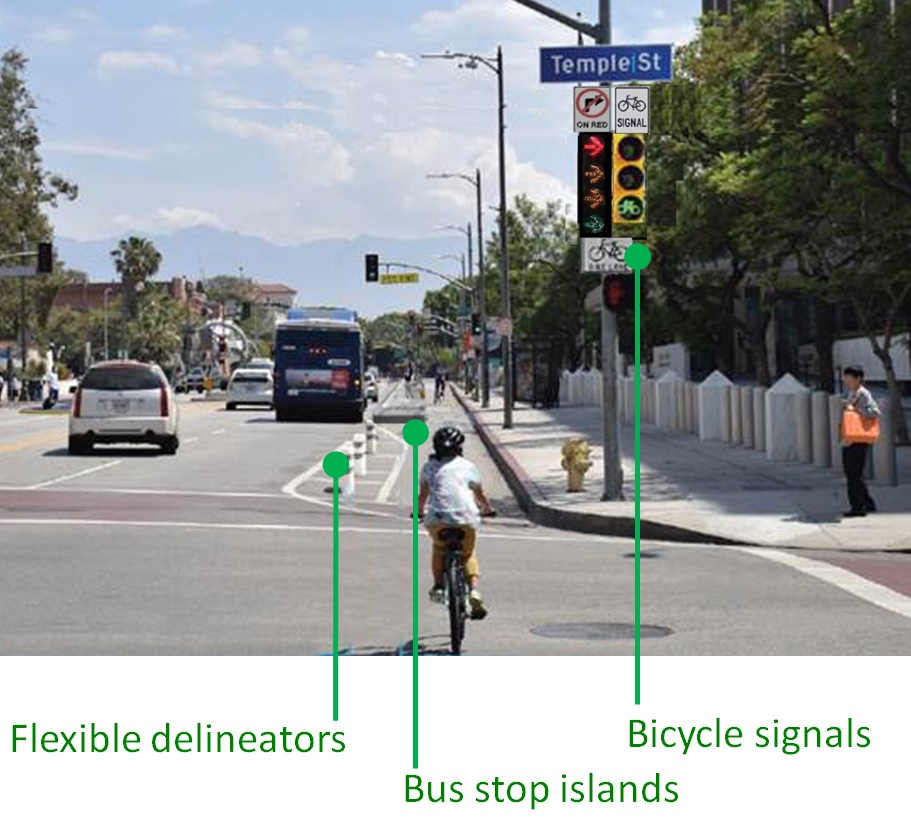
L.A.’s First Bike Traffic Signals
"Bike signals are not required for protected bike lane intersections; Long Beach uses them, Temple City’s Rosemead Boulevard and L.A.’s Reseda Boulevard do not," writes Linton on Tuesday about the ribbon-cutting for the new bike lane to be held Thursday.
"Bicycle signals make crossing intersections safer for bicyclists by clarifying when to enter an intersection and by restricting conflicting vehicle movements," according to the National Association of City Transportation Officials.
Bike signals will advance cycling by tackling two issues: First, they address the general issue of increasing riding safety, perceived to be the largest barrier in an April 2015 People for Bikes survey:
Safety concerns are the biggest barrier for most people, even among active riders. Overall, 52% of the adults surveyed are worried about being hit by a motor vehicle.
Second, they target the main location of bicycle crashes with motor vehicles, traffic intersections. According to the Federal Highway Administration, "Forty-one percent of [bicycle and pedestrian] crashes occurred at roadway intersections, and an additional 8 percent occurred in driveways or alley intersections. [Pedestrian and Bicycle Crash Types [PDF].
L.A.’s First Two-Phase Left Turn Markings
More intersection safety is offered for cyclists who prefer not to make a left turn with motor vehicles from the left lane, or designated left turn lane. "The Los Angeles Street project also features green boxes that support cyclists’ two-phase left turns," writes Linton.
Instead of stressful merging through car traffic to make a vehicular left turn, cyclists make a low-stress left turn similar to the way a pedestrian would.
Look for the box is in the bike lane, not the left-turning lane. It is also known as a "two-stage turn queue box."
L.A.’s First Protected Bikeway Transit Islands
Cyclists avoid conflict with buses, but they need to watch for transit passengers walking across the bike lane from the sidewalk or the transit island.
Linton includes lots of great photos of the Los Angeles Street bike lane. Take a 20-second tour of the new lane in this video.
Look for more protected bike lanes in Los Angeles to be opening on Venice Boulevard, Van Nuys Boulevard, and Figueroa Street, adds Linton.
[The post was updated to reflect the correct facilities on Temple City's Rosemead Boulevard.]
Read the full story: Los Angeles Street Protected Bike Lanes Ribbon-Cutting This Thursday

Scooter Revenue, Empty Streets Allow for Quick Construction of Bike Lane in L.A.
A busy corridor, popular with bike and scooter riders, is gaining a new protected bike lane in Los Angeles.
Nation's Top Safety Board Recommends Protected Bike Lanes
The NTSB chair issued a stark warning on Nov. 5: "If we do not improve roadway infrastructure for bicyclists, bicyclists will die who otherwise would not," stated Robert Sumwalt in introducing their first report in 47 years devoted to bike safety.
L.A.'s Strategy for 'Universal Basic Mobility'
Los Angeles Department of Transportation General Manager Seleta Reynolds emphasizes the importance of riders' perspective on access when redesigning the transit system.

Planetizen Federal Action Tracker
A weekly monitor of how Trump’s orders and actions are impacting planners and planning in America.

Amtrak, CN end decades-long dispute with eight-year agreement
The new operating agreement establishes an updated framework for the companies to work together, including processes to resolve disputes.

Northwest rail fans eager for Sept. 30 debut of Amtrak’s Airo fleet
Get ready for that new train smell and more seats. But they won’t go faster or run more frequently on the Cascades route in Washington and Oregon.

Brightline Florida files for bankruptcy
The transit company is over $5 billion in debt.

St. Louis Metro to test if single-car trains can reduce operating costs, maintain rider satisfaction
The pilot program will run from October to spring 2027, and begin with one single-car train operating on Metrolink’s Red and Blue lines.

Pennsylvania is building data centers in abandoned mines
Housing data centers in mines provides an alternative to destroying local forests and may spare residents from data centers’ noise and air pollution.

FREE Course: Walkable City 1: Why Walkability?
After describing his path towards focusing on walkability as the essence of good planning, Jeff Speck marches through his five principal reasons for making more walkable places.
Reinventing Malls: Planning Alchemy—Turning Gray Fields Into Gold
The course focuses on the opportunities and imperatives that shape reinvention of mall sites.

City of Thousand Oaks
City of Wisconsin Rapids
Harvard University Graduate School of Design
The Architects Foundation
University of Cincinnati Online
The Pocatello Development Authority
The Urban Renewal Agency of the City of Pocatello