It's hard to imagine a policy that so comprehensively acts to create disincentives for sprawl gaining political traction anywhere in the United States.



[Updated 5/23/2016] "With 3.5 million people set to move into the Greater Toronto and Hamilton Area over the next 25 years, the province is promising sweeping changes to manage smart growth and curb urban sprawl that’s crippling the region," according to an article by San Grewal.
Ontario Finance Minister Charles Sousa was joined by three other ministers to announce the "broad new measures the province is taking to properly manage future growth," according to Grewal. Sousa called the growth management strategy historic. The growth strategy is still only a proposal, regardless. "Many of the bold changes which will be reviewed until the end of September, before they can be incorporated into existing legislation," explains Grewal.
Among the proposed changes:
- Dense "pre-zoning" requirements along transit corridors.
- Requiring infill to comprise 60 percent of new residential development
- Increased commercial density to lessen the development of greenfield employment centers.
The article also includes a poll asking for reader's opinions of sprawl. The overwhelming majority of respondents say "it’s about time" the provincial government did something about sprawl.
Mississauga Mayor Bonnie Crombie produced a press release coinciding with the announcement of the growth strategy. The press release describes in more detail the process that produced the growth plan, as well as unequivocally voicing support for planning as the solution to the growth challenges facing the region.
[The post was updated to give proper credit to the current mayor of Mississauga.]
Read the full story: Ontario setting new rules to end era of suburban sprawl across GTA


Growth Plan Debate Heats Up in Toronto
The question of how and where to grow is causing controversy in Toronto. A recent op-ed picks a side.

For Lack of Density: Ontario Rejects Toronto's Downtown Plan
Local control loses ground to provincial preemption north of the border.
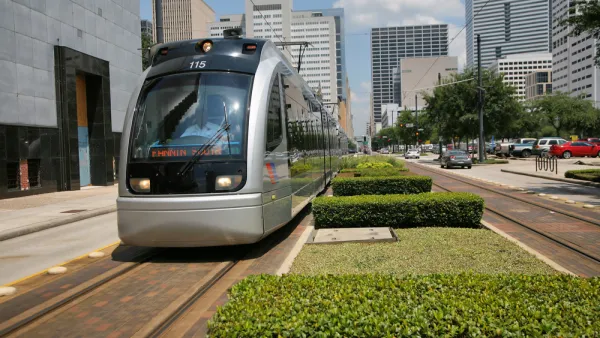
Two Studies Show How Light Rail Benefits Houston
Finally, the city seems to be reaping benefits from a major investment in public transportation.

Planetizen Federal Action Tracker
A weekly monitor of how Trump’s orders and actions are impacting planners and planning in America.

Northwest rail fans eager for Sept. 30 debut of Amtrak’s Airo fleet
Get ready for that new train smell and more seats. But they won’t go faster or run more frequently on the Cascades route in Washington and Oregon.

Trump is considering data centers on 6 states' public land — some state officials say they had no idea
If the administration approves the proposed projects, data center and data center-related developments will cover 17,600 acres of public land.

After decades of planning, Sacramento gains new light rail station
Trains will arrive every 15 minutes during peak hours and every 30 minutes during non-peak hours.

Massive tunnel-boring machine breaks ground on Gateway Project
The Trump administration revoked funding for the project in October 2025, and then restored it earlier this year.

Airo trainsets begin service on Amtrak Cascades route
The trains feature panoramic windows, complementary wifi and over 300 seats per train set.

FREE Course: Walkable City 1: Why Walkability?
After describing his path towards focusing on walkability as the essence of good planning, Jeff Speck marches through his five principal reasons for making more walkable places.
Reinventing Malls: Planning Alchemy—Turning Gray Fields Into Gold
The course focuses on the opportunities and imperatives that shape reinvention of mall sites.

City of Thousand Oaks
City of Wisconsin Rapids
Harvard University Graduate School of Design
The Architects Foundation
University of Cincinnati Online
Northern Illinois Transit Authority (NITA)
The Pocatello Development Authority
The Urban Renewal Agency of the City of Pocatello