For decades, New York City's boom times lay deep in the past. Now that the city's growing again, Aaron Renn says New York may need to take cues from the Sun Belt, of all places.


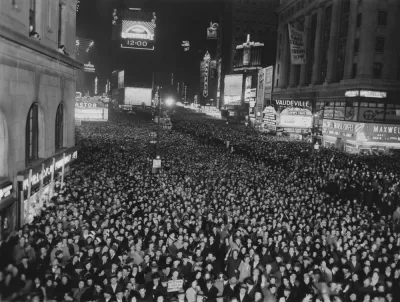
Like many of its northeastern brethren, New York had long been a manager of its own slow decline. But now, for the nation's biggest city at least, that has obviously changed. Aaron Renn writes, "One reason New York is struggling to deal with subway crowding – and housing and other matters – is that it is now facing a kind of problem northern cities haven't had to deal with in a long, long time: the problem of growth."
After losing population for years, the current boom period simply "refilled" the city to previous capacity. "This was almost like getting free money for places like New York. Their infrastructure had been built for a larger population – in some cities a much larger population – and so there was no need to expand it to accommodate the growth. Life was good."
But now, the city's resurgence threatens to overwhelm public and private infrastructure already in place. "Regardless of the specifics, the question is, what does New York need to do to start thinking like a growth city again? [...] If NYC doesn't figure it out, we already see the consequences: overcrowded trains and soaring housing costs [...]" as well as infrastructure that might not withstand, say, a string of future Hurricane Sandys.
Read the full story: Sun Belt Problems Come to New York City

Many New Yorkers Face Punishing Transit Commutes
As sky-high real estate prices force many lower-income New Yorkers to the periphery, they're paying an additional price in lengthy transit commutes. Meanwhile, real estate interests that benefit from transit investment bear few of its costs.
As New York Plants One Million Trees, Benefits—and Some Burdens—Grow
The city’s MillionTrees program fights asthma and global warming. But tightening maintenance budgets, increasingly severe weather and decades-old planting decisions complicate trees’ contribution.
Federal cuts to voucher program put 9,000 New Yorkers at risk of homelessness
The Emergency Housing Voucher program is ending years ahead of schedule, forcing housing agencies to find new ways to support roughly 70,000 households nationwide.

Planetizen Federal Action Tracker
A weekly monitor of how Trump’s orders and actions are impacting planners and planning in America.

Amtrak, CN end decades-long dispute with eight-year agreement
The new operating agreement establishes an updated framework for the companies to work together, including processes to resolve disputes.

Judges permit Denver to divert 77,000 acre feet from the Colorado River for reservoir expansion
Overuse and climate change have caused the Colorado River’s water levels to plummet.

South Chicago development proposal would 'upzone' neighborhoods to increase density
The South Chicago Land Use Framework plan also aims to promote pedestrian and transit-oriented developments.

Boston has spent millions making the Green Line more accessible — and there’s no end in sight
While the city has invested millions into expanding and adding platforms to the Green Line to make it more accessible, new train cars set to arrive next year will be too tall for disabled passengers to board without raising the current platforms.

Idaho may see an 18% drop in federal surface transit funding — the largest estimated cut in the US
Transit systems in rural communities are much more reliant on federal funding to provide their services.

FREE Course: Walkable City 1: Why Walkability?
After describing his path towards focusing on walkability as the essence of good planning, Jeff Speck marches through his five principal reasons for making more walkable places.
Reinventing Malls: Planning Alchemy—Turning Gray Fields Into Gold
The course focuses on the opportunities and imperatives that shape reinvention of mall sites.

City of Wisconsin Rapids
Harvard University Graduate School of Design
KFH Group Inc.
The Architects Foundation
University of Cincinnati Online
The Pocatello Development Authority
The Urban Renewal Agency of the City of Pocatello