Seattle's updated list of masonry structures at risk from earthquake includes many structures in the Capitol Hill district. Property owners are not currently mandated to retrofit the buildings they own.



A new report on seismic risk details which Seattle structures would be most vulnerable during an earthquake. "The City of Seattle has added some 300 buildings to its list of old brick structures most at risk of damage or collapse in the event of a major earthquake. Among the 1,160 'unreinforced masonry structures' [URMs] counted in a recent report, Capitol Hill continues to have the most of any neighborhood in the city."
Bryan Cohen writes, "URMs, as defined by the city, are old brick buildings that were originally built without steel reinforcements and with inadequate ties between building elements. They are considered to be vulnerable to collapse during severe earthquakes."
While URM property owners must retrofit during major upgrades or changes of use, they aren't required to do so by default. This updated inventory of URMs may be an important step toward such a mandate.
Read the full story: Expanded list of seismically risky buildings could spur a new development wave on Capitol Hill


San Francisco Considers More Aggressive Measures to Earthquake-Proof High Rises
The city has proposed tighter rules for new construction and a more active approach to securing existing tall structures from collapse.
Napa Earthquake Shows Urgency of Building Retrofits
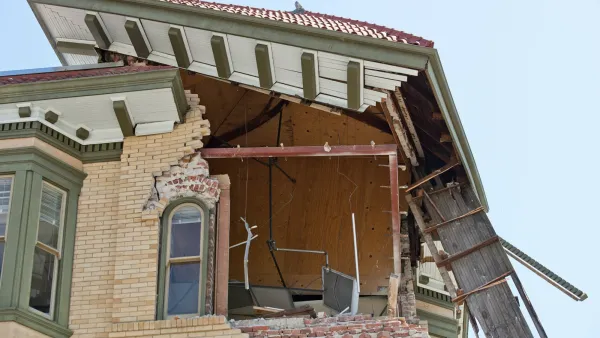
Sunday's powerful Bay Area earthquake brought attention to the urgent need to retrofit existing buildings in California. One expert stated the damage in Napa "was predictable." Do you know the three types of construction that need to be reinforced?
Op-Ed: Portland Should Fully Commit to Earthquake Preparedness
An editorial calls for Portland, Oregon to approve a requirement that warning signs be placed on unreinforced historic buildings. An argument is made for further measures, and a greater sense of urgency.

Planetizen Federal Action Tracker
A weekly monitor of how Trump’s orders and actions are impacting planners and planning in America.

Amtrak, CN end decades-long dispute with eight-year agreement
The new operating agreement establishes an updated framework for the companies to work together, including processes to resolve disputes.

Judges permit Denver to divert 77,000 acre feet from the Colorado River for reservoir expansion
Overuse and climate change have caused the Colorado River’s water levels to plummet.

NYC DOT wants faster, more permanent street upgrades
The city is examining ways to build more concrete infrastructure without getting entangled in 'decades-long' projects.

'Something we’ve never seen before:' rising utility rates could strain city finances nationwide
Data centers, climate change and other factors have caused utility rates in the United States to increase by 38% since 2020.

Trump to overrule local leaders, lease millions of acres of America’s Pacific Island territories’ seafloors to mining companies
International law says that the Indigenous people of America’s territories have a right to prior and informed consent regarding projects that impact their countries.

FREE Course: Walkable City 1: Why Walkability?
After describing his path towards focusing on walkability as the essence of good planning, Jeff Speck marches through his five principal reasons for making more walkable places.
Reinventing Malls: Planning Alchemy—Turning Gray Fields Into Gold
The course focuses on the opportunities and imperatives that shape reinvention of mall sites.

Harvard University Graduate School of Design
KFH Group Inc.
Greater Baltimore Committee
The Architects Foundation
University of Cincinnati Online
The Pocatello Development Authority
The Urban Renewal Agency of the City of Pocatello