St. Louis Public Radio details the work of a local researcher who says the segregation of today's St. Louis is the result of deliberate, decades-long federal housing policy.


"A researcher with the Economic Policy Institute says the federal government needs to recognize that it played a deliberate role in creating racially segregated neighborhoods in cities like St. Louis," according to an article by Camille Phillips.
The researcher, Richard Rothstein, recently presented at the Missouri History Museum Symposium, "[drawing] a direct line between today’s segregated schools and neighborhoods and two federal housing programs from the 1930s, 40s and 50s: public housing and subsidized construction."
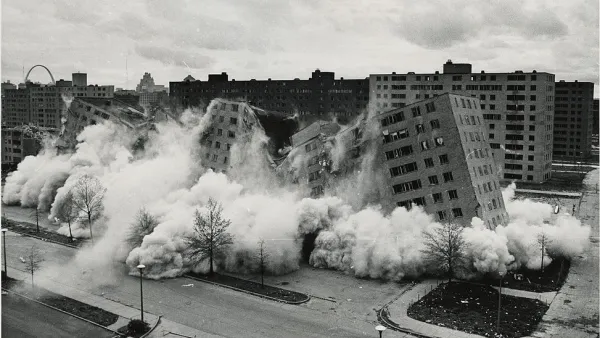
The article presents more of the details of Rothstein's argument, which traces roots back to the 1930s and finds effects in St. Louis neighborhoods Desoto-Carr and projects like Pruitt-Igoe. Rothstein also argues that Section 8 vouchers and low-income housing credits "are presently used to reinforce segregation."
Read the full story: Researcher: St. Louis segregation is a legacy of deliberate federal policy
More Cities and Counties Arming Renters Against Source of Income Discrimination
St. Louis County is considering fair housing legislation that would prevent source of income discrimination, as many cities in the region have already done, and many more are also considering.
Land Use Regulation's Legacy of Racial Segregation
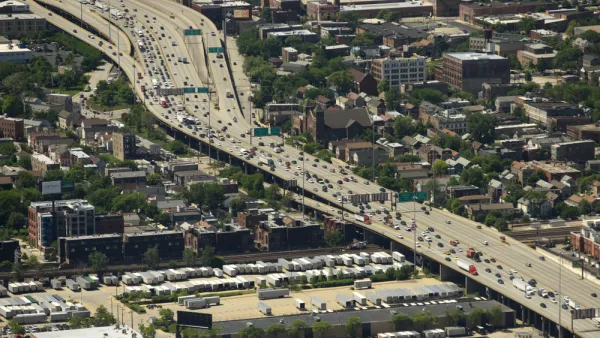
An investigative feature by Governing magazine blames the history of land use regulations like zoning and redlining for the racial segregation of contemporary communities all over the state of Illinois and the country.
The Massive Redevelopment Plans for North St. Louis Failed—What Next?
Detroit has Dan Gilbert, and for a few years, it looked like St. Louis had Paul McKee. Now that McKee's massive plans for the redevelopment of North St. Louis have failed expectations, what has been lost and what, potentially, can still be gained?

Desperate measures: Advocates weigh draining Lake Powell to fill Colorado River
Draining the reservoir could reduce evaporation losses by a couple hundred thousand acre-feet.

Eastern Nebraska is running out of electricity
Data centers and electrification are straining eastern Nebraska’s grid, throttling economic development.

Move over, LA: St. Louis gears up for Olympics, invests millions in downtown redevelopment
The Missouri city will host the 2028 Olympic soccer group stage and knockout matches.

Mass. votes against statewide minimum lot size for single-family homes
Over 2 million residents voted on Question 7; it was decided by just over 30,000 votes.

Maryland’s $15 billion bridge project gains key approval
The Maryland Transit Authority said the project will create over 60,000 jobs and add $23 billion to the local economy.

‘No clear next steps’ for Chicago's permanent festival grounds
Eleventh Ward Ald. Nicole Lee has suggested Soldier Field as a possible location for the permanent event space.

FREE Course: Walkable City 1: Why Walkability?
After describing his path towards focusing on walkability as the essence of good planning, Jeff Speck marches through his five principal reasons for making more walkable places.
Reinventing Malls: Planning Alchemy—Turning Gray Fields Into Gold
The course focuses on the opportunities and imperatives that shape reinvention of mall sites.

City of Rosemead
Rutgers University, Edward J. Bloustein School of Planning and Public Policy
One Hundred Miles
University of Michigan School for Environment and Sustainability (SEAS)
Hunter College, City University of New York (CUNY)
The Architects Foundation
City of Cambridge
The Pocatello Development Authority
The Urban Renewal Agency of the City of Pocatello