The message was so atypical for a politician wooing votes. "We'll put coal miners out of business," Hillary Clinton warned the audience at Sunday night's Democratic Town Hall in Columbus, Ohio, giving credence to President Obama's "War on Coal."


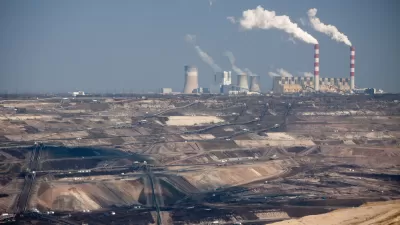
One need not read Planetizen to know the future in coal mining is not exactly bright. Warning that "you're going to lose your jobs" would have been harsh enough, but the former secretary of state went one better at CNN's Democratic Town Hall on March 13: "We're going to do it to you!," was essentially her message, or at least the way it came out.
"Clinton may have dug herself a deep hole across Kentucky and Appalachia, even though she may not have intended to do so - while possibly gaining votes in other, greener states," writes James Bruggers of the Louisville, Ky.-based Courier-Journal.
Clinton was answering the question: "Make the case to poor whites who vote Republican why they should vote for you and your economic policies." The transcript (or 45-second YouTube video) provides the context of her damaging words.
...I'm the only candidate which has a policy about how to bring economic opportunity using clean renewable energy as the key into coal country. Because we're going to put a lot of coal miners and coal companies out of business, right...
And we're going to make it clear that we don't want to forget those people. Those people labored in those mines for generations, losing their health, often losing their lives to turn on our lights and power our factories.
Bruggers wrote last November about Clinton's "$30 billion plan to boost coal communities which have suffered because coal has been losing out to cheaper, cleaner natural gas as the fuel of choice for electricity generation." But that's far different than assuming responsibility for the loss of jobs, as opposed to the retraining of workers who lose their jobs due to market forces.
To be sure, CNNMoney economics reporter Patrick Gillespie writes, "Hillary Clinton can't kill coal. It's already dying." While "(h)er critics say she and President Obama are at war with coal companies...the war might already be over. Clinton won't have much coal to put out of business: the industry is already gutted."
The number of coal workers in the United States -- 57,700 -- is at a record low since data was tracked. Coal employment declined in every single month last year and it's down dramatically from the mid-1980s when there were over 175,000 coal jobs.
Clinton's main point Sunday night was that she plans to replace coal jobs with clean energy jobs in places like Boone County [West Virginia, unemployment 10 percent. West Virginia had the highest unemployment rate in the country of 6.7% in the last quarter of 2015, according to the Economic Policy Institute]. So far, that hasn't happened.
In fact, rather than focusing on Hillary Clinton's self-damaging way of referring to what may be an inevitable loss of coal-related jobs, regardless of EPA regulations like the Clean Power Plan, collectively known by coal proponents as President Obama's War on Coal, more attention should be placed on the intentional point of her answer.
"There's no one transitioning into green energy jobs," says Kris Mitchell, director of development for Boone County. "Some people still believe coal will come back."
Read the full story: Clinton: We'll put coal miners out of business
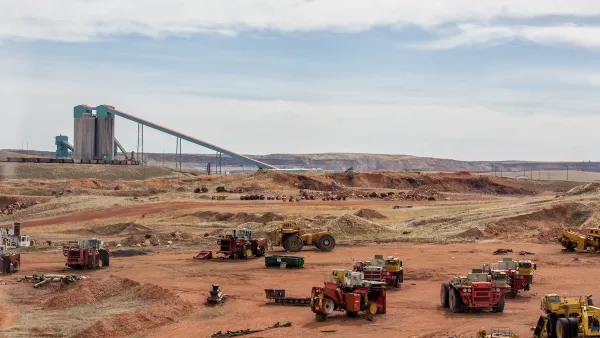
A Win for ‘Keep it in the Ground’
Coal mining in Wyoming will take a major hit as a result of a U.S. Department of Interior plan to cease future leasing of coal mines in the nation's most productive coal mining basin. The decision casts a spotlight on the presidential election.
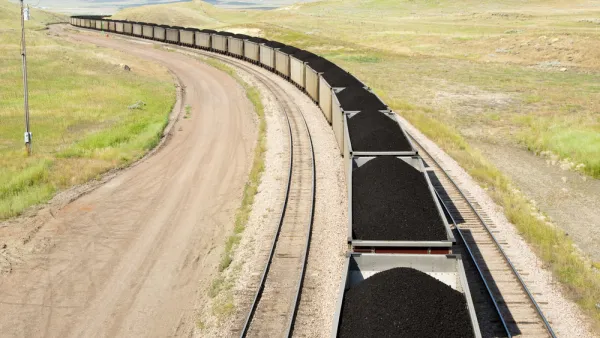
Mountain Coal States vs. West Coast Cities
A legal battle is being waged between the coal-exporting states of Utah, Wyoming, and Montana and coastal cities in California, Oregon, and Washington that pits the power of local land-use authority against the protection of interstate commerce.

When the U.S. Economy Is 'Too Strong' to Spend on Infrastructure
A low unemployment rate means major investments by the federal government could ultimately harm the economy.

Planetizen Federal Action Tracker
A weekly monitor of how Trump’s orders and actions are impacting planners and planning in America.

California plans to bury El Niño’s downpour
If the state plays its cards right, it may be able to store a billion acre-feet of El Niño’s water in aquifers.

Desperate measures: Advocates weigh draining Lake Powell to fill Colorado River
Draining the reservoir could reduce evaporation losses by a couple hundred thousand acre-feet.

Mamdani’s pied-à-terre tax survives legal challenge
A panel of judges found that the plaintiffs failed to demonstrate injury as a result of New York City's implementation of the tax.

Eastern Nebraska is running out of electricity
Data centers and electrification are straining eastern Nebraska’s grid, throttling economic development.

Seattle passes record-breaking transit services expansion
Proposition 1 will double the city’s transit tax to add 95,000 more bus trips and preserve 180,000 bus trips annually.

FREE Course: Walkable City 1: Why Walkability?
After describing his path towards focusing on walkability as the essence of good planning, Jeff Speck marches through his five principal reasons for making more walkable places.
Reinventing Malls: Planning Alchemy—Turning Gray Fields Into Gold
The course focuses on the opportunities and imperatives that shape reinvention of mall sites.

City of Rosemead
Rutgers University, Edward J. Bloustein School of Planning and Public Policy
One Hundred Miles
University of Michigan School for Environment and Sustainability (SEAS)
Hunter College, City University of New York (CUNY)
The Architects Foundation
City of Cambridge
Montrose County
The Pocatello Development Authority