When Frank Gehry's involvement in the L.A. River restoration was announced in August 2015, the firm had already been conducting research on the project for nearly a year. For some time after that, details were scant and speculation abounded.


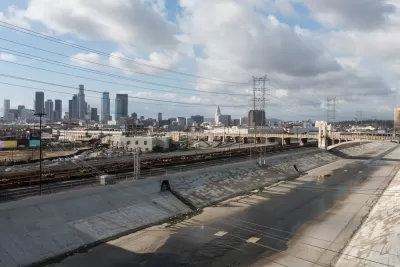
In a presentation at VerdeXchange in Los Angeles last month, Tensho Takemori of Gerhy Partners delved into the details of the firm’s approach to the river's hydrology—beginning with the very basics.
"We started by asking our client [the LA River Revitalization Corporation] for a 3D model of the Los Angeles River,” Takemori says. “We found out something interesting: there wasn’t one."
And though a number of plans and studies have taken the river as an object over the years, Takemori says none have crossed jurisdictional lines to paint a picture of the river as a whole.
So Gehry Partners embarked on an extensive research period to start filling in the gaps. The team is now compiling a 3D model of about 70 percent of the river’s 51-mile length (the portion that has a concrete bottom), and has identified a set of data topics to evaluate. Ultimately, GIS data on water flow, public health, greenhouse gas emissions, the arts, and more will be able to be overlaid with the model.
"We’re trying to formulate a single comprehensive database that everybody who works on the river can use," Takemori explains.
Additionally, by determining correlations among the various sets of data, the firm hopes to build a case for state and federal agencies that investment in the river can yield returns in a number of social, environmental, and economic areas.
That multi-faceted approach was echoed in VerdeXchange's keynote address by LA Mayor Eric Garcetti, who offered a vision of the river that was by turns personal, historical, and practical. On the following panel with Takemori, veteran environmentalist Joe Edmiston and L.A. Deputy Mayor Barbara Romero also provided insights into the many ecological and community-based impacts the river restoration could have.
VerdeXchange’s "A River Runs Through It" session, which included both the keynote and the panel, is reprinted in The Planning Report.
FULL STORY: VX2016 LA River Plenary Featured: Mayor, Gehry Partners, Edmiston, Romero


Gehry's Plans for Los Angeles River Restoration Gaining Clarity
Details are emerging in the controversial effort by Gehry Partners, LLP to plan a new vision for the Los Angeles River. So far, however, Gehry Partners seems to have been listening more than plotting or drawing.
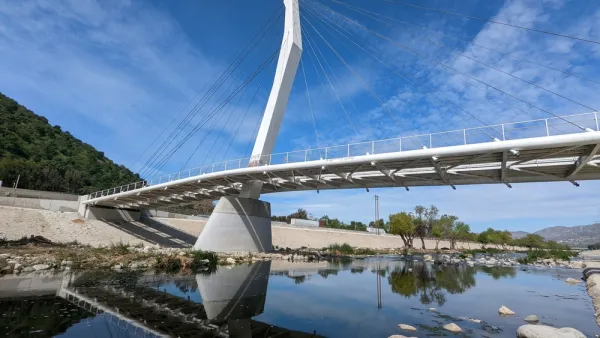
A New Master Plan for the Los Angeles River
The L.A. County Board of Supervisors voted to approved a new master plan for the L.A. River—the “Reimagined River.”
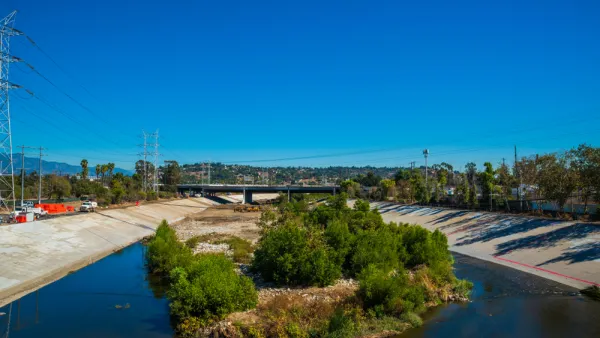
A Comment for the L.A. River Master Plan
Five themes proposed to achieve justice and sustainability for the Los Angeles River and its surrounding communities.

Planetizen Federal Action Tracker
A weekly monitor of how Trump’s orders and actions are impacting planners and planning in America.

The state-sanctioned urbicide of Austin
People don’t kill cities. Freeways do.

US to reduce Colorado River water deliveries to Mexico
A new Colorado Treaty amendment reduces Mexico’s Colorado River water allocation by 250,000 acre feet.

Colorado’s Largest Data Center Could Rise Next to Homes — Without a Public Hearing
The proposed campus would consume 11 times the power of Denver International Airport; as it has across the country, opposition mounts.

5 New England states march closer to 800 megawatt wind energy project
Securing federal approval for the project may be complicated under the Trump administration, which has historically been hostile towards domestic wind power.

Baltimore to break ground on $50 million Transit Priority Project
The project will bring faster bus trips, safer streets and better bike connections to Baltimore.

FREE Course: Walkable City 1: Why Walkability?
After describing his path towards focusing on walkability as the essence of good planning, Jeff Speck marches through his five principal reasons for making more walkable places.
Reinventing Malls: Planning Alchemy—Turning Gray Fields Into Gold
The course focuses on the opportunities and imperatives that shape reinvention of mall sites.

Eagle County Government
Harvard University Graduate School of Design
Nashville Planning Department
The Architects Foundation
University of Cincinnati Online
The Pocatello Development Authority
The Urban Renewal Agency of the City of Pocatello
Journal of the American Planning Association