A 10-minute commute to lower Manhattan has made this once dingy city into the fastest growing in the Garden State. Yet from an historic perspective, Jersey City was a "shrinking city," not unlike Detroit or Youngstown, until 25 years ago.


"An influx of new arrivals priced out of Manhattan and Brooklyn is helping make it the fastest growing metropolitan area in New Jersey, with some 262,000 residents in 2014, up nearly 6 percent from 2010, according to United States census data," writes Ronda Kaysen, the Ask Real Estate columnist for The New York Times. The city's population peaked in 1930 at 316,715.
Developers are rushing to build, with some 7,000 units of housing under construction and another 19,000 approved — more than in any other city in the state, according to the mayor’s office.
Central to the city's growth are two PATH subway stations. The Grove Street PATH station offers an incredible 10-minute to the World Trade Center Transportation Hub or 20 minutes to get to West 33rd Street.

credit: PATH
"The Journal Square neighborhood, which is in the center of the city, west of downtown and south of the Heights, is bracing for more change," writes Kaysen. "With the Jersey City waterfront and downtown nearly built out, developers are moving inland, plucking up parcels close to transit; the area around the Journal Square PATH station has become a prime destination."
There was no mention of the the city's third PATH station, Exchange Place. Per Wikipedia, "(a) high concentration of highrise office and residential buildings in the city are located in the district radiating from Exchange Place." The neighborhood is also served by the Hudson-Bergen Light Rail line operated by NJ Transit.
Kaysen goes into great detail on the challenges, such as gentrification, increased traffic, facing particular neighborhoods, and schools: "After nearly three decades of state oversight, Jersey City will regain full control over its schools this spring."
To bring the 2016 presidential election into discussion, the city's second Trump development, Trump Bay Street, a 484-foot, 50-story, 447-unit rental skyscraper rental tower, will open at the end of the year. That's 665 units per acre. No mention if eminent domain was used.
The 55-story, 532-foot Trump Plaza Jersey City, completed in 2008 is the Garden State's fourth tallest building, and tallest residential building, as of January 2015 according to NJ.com.
FULL STORY: Moving to Jersey City? Join the Club.

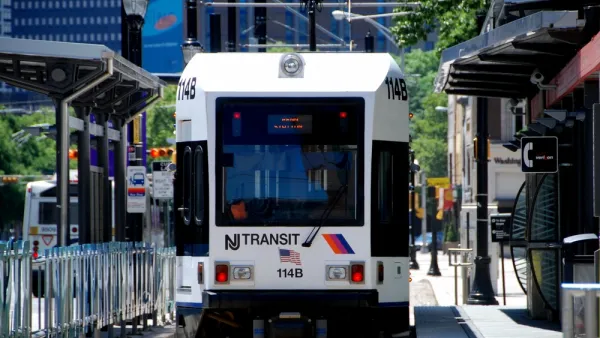
New Jersey Light Rail Extension Expected to Spur New Development
The newest extension of the Hudson-Bergen Light Rail line is expected to serve 8,000 new residential units along the Hackensack River.
Terrifying Train Crash at Hoboken Terminal on Thursday Leaves One Dead
Disaster struck New Jersey Transit commuters at 8:38 AM on Sept. 29 when train #1614 failed to stop at the end ot the track and slammed into the wall, then the ceiling of the historic station, killing at least one person and injuring up to 100.
Port Authority Recommends Cutting PATH Service
The Port Authority released a controversial report over the weekend that recommends cutting overnight and weekend service for Port Authority Trans-Hudson (PATH) service. So far, the governors of New York and New Jersey support the plan.

The state-sanctioned urbicide of Austin
People don’t kill cities. Freeways do.

US to reduce Colorado River water deliveries to Mexico
A new Colorado Treaty amendment reduces Mexico’s Colorado River water allocation by 250,000 acre feet.

New Jersey’s second-largest city bans standalone data centers
Jersey City will continue to allow co-location facilities, such as those meant for research institutions that store their own data.

Amtrak not solely to blame for New Jersey commuter rail's unreliability, report finds
A new study from the Garden State Initiative found that NJ Transit’s budget grew 20% across a 4 year period, but reliability declined significantly over the same period.

EPA erases limits on planet-warming pollution from power plants
Under Monday’s plan, power plants would still have some limits on how much mercury, arsenic and other contaminants they can emit.

Phoenix announces new on-demand transit service, more frequent RAPID buses
Both new services will launch in October, and are part of Phoenix's Project Effective Access Solutions for Easing Congestion.

FREE Course: Walkable City 1: Why Walkability?
After describing his path towards focusing on walkability as the essence of good planning, Jeff Speck marches through his five principal reasons for making more walkable places.
Reinventing Malls: Planning Alchemy—Turning Gray Fields Into Gold
The course focuses on the opportunities and imperatives that shape reinvention of mall sites.

Eagle County Government
Harvard University Graduate School of Design
Nashville Planning Department
The Architects Foundation
University of Cincinnati Online
The Pocatello Development Authority
The Urban Renewal Agency of the City of Pocatello
Journal of the American Planning Association