The number of commuters taking to bicycle in the city have tripled since 2000, while commuting by car has been cut in half.


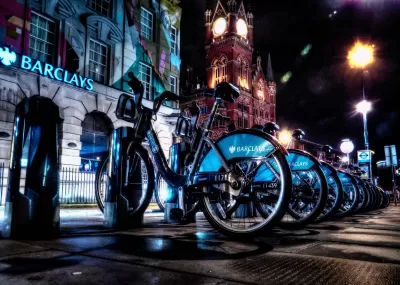
Since the turn of the century, London has seen the number of commuters traveling by bike triple from 12,000 daily commuters to 36,000. Jason Sayer of The Architect's Newspaper reports that despite the growth, London still lags behind other European cities, including Madrid and Oslo, which have moved to limit automobile access to their city centers. However, as ridership grows better infrastructure is being built to meet demands for safety and access.
Cycle “superhighways” have been introduced by Mayor Boris Johnson during his tenure, though many argue that while these are a step forward, they still fail to provide a physical barrier between cyclists and drivers.
Read the full story: Pedal Power: London Could Soon Have More Cyclists Than Motorists On Its Streets


Planetizen Federal Action Tracker
A weekly monitor of how Trump’s orders and actions are impacting planners and planning in America.

Colorado’s Largest Data Center Could Rise Next to Homes — Without a Public Hearing
The proposed campus would consume 11 times the power of Denver International Airport; as it has across the country, opposition mounts.

Amtrak, CN end decades-long dispute with eight-year agreement
The new operating agreement establishes an updated framework for the companies to work together, including processes to resolve disputes.

'This is going to be painful:’ Virginia stares down $1.7 billion funding gap for highway maintenance
The state may address the deficit by shifting $290 million from its construction budget to maintenance projects.

Judges permit Denver to divert 77,000 acre feet from the Colorado River for reservoir expansion
Overuse and climate change have caused the Colorado River’s water levels to plummet.

Amtrak, CN end decades-long dispute with eight-year agreement
The new operating agreement establishes an updated framework for the companies to work together, including processes to resolve disputes.

FREE Course: Walkable City 1: Why Walkability?
After describing his path towards focusing on walkability as the essence of good planning, Jeff Speck marches through his five principal reasons for making more walkable places.
Reinventing Malls: Planning Alchemy—Turning Gray Fields Into Gold
The course focuses on the opportunities and imperatives that shape reinvention of mall sites.

KFH Group Inc.
Greater Baltimore Committee
Eagle County Government
The Architects Foundation
University of Cincinnati Online
The Pocatello Development Authority
The Urban Renewal Agency of the City of Pocatello