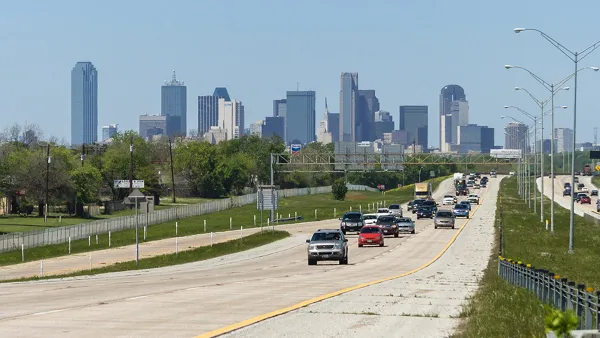
Pitched as a necessary addition to reduce congestion on interstates 30 and 35E as they pass Downtown Dallas, the Trinity Parkway is likely to induce one million additional vehicle miles traveled a day.


Brandon Formby reports on effects of the controversial proposed Trinity Parkway project in Dallas: "According to North Texas traffic projections for 2035, drivers who pass through a 34.3-mile area around the road will collectively drive 8 million miles a day if Trinity Parkway is built. But they’ll only drive 7 million miles a day that same year if it isn’t."
Moreover, "while the toll road’s existence is expected to help drivers around the urban core spend 4,817 fewer hours sitting in traffic jams each day, the time they’ll spend driving overall will jump about 11,677 hours a day."
Formby also devotes a lot of time in the article to provide the political context for the debate, as well as the planning perspective on the consequences of the Trinity parkway proposal. As for the current status of the project, Formby provides the following:
Its traffic impacts for 2035 are based off a large-scale version of the road that federal highway authorities say they expect to eventually be built. The Dallas City Council, meanwhile, has commissioned a team of experts and government employees to design a first phase of construction that will limit the number of lanes and interchanges with other highways.
Read the full story: Trinity Parkway will prompt Dallas drivers to travel an extra 1 million miles a day
Breaking: Controversial Trinity Toll Road Officially a No-Go
Dallas has ended decades of debate about a highway project proposed to run along the Trinity River.
In Support of the Trinity Toll Road in Dallas
The Trinity Toll Road project in Dallas is one of the most controversial ongoing infrastructure and highway projects in the country. A Dallas Morning News columnist suggests the project's opponents should act like adults.
Does Peak Car Mean the End of Induced Demand?
Aaron Renn provides a dissenting argument on the implications of peak car, namely, "if we’ve really reached peak car, maybe we really can build our way out of congestion after all."

Planetizen Federal Action Tracker
A weekly monitor of how Trump’s orders and actions are impacting planners and planning in America.

Washington state to charge fee to drivers with fuel-efficient cars
Revenue from the fee will go towards supporting the state’s highways.

Illinois considers spending $1 billion in taxpayer money on data center
A quantum computing campus and data center are currently under construction in Chicago.

Senate passes bill overhauling permitting
The bill still needs to pass the House.

Did data centers change how voters cast their ballots?
Texas, Ohio, and Georgia all flipped party control. But in rural counties, the effect of local data centers was mixed.

Amtrak invests in eight new Airo trainsets
The new trainsets will begin serving passengers in 2031.

FREE Course: Walkable City 1: Why Walkability?
After describing his path towards focusing on walkability as the essence of good planning, Jeff Speck marches through his five principal reasons for making more walkable places.
Reinventing Malls: Planning Alchemy—Turning Gray Fields Into Gold
The course focuses on the opportunities and imperatives that shape reinvention of mall sites.

City of Charlotte
City of Rosemead
Rutgers University, Edward J. Bloustein School of Planning and Public Policy
University of Michigan School for Environment and Sustainability (SEAS)
Hunter College, City University of New York (CUNY)
The Architects Foundation
University District Partnership