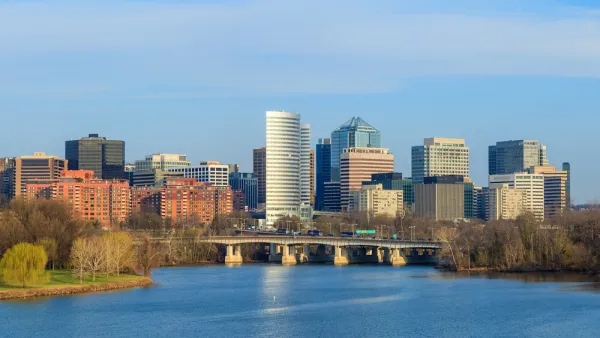
Tysons, long famous for its office-park dominated version of suburbia, just approved a massive project that furthers an ongoing, dramatic urban transformation outside of Washington, D.C.


"The latest, and among the largest, efforts to rid Tysons of its suburban-style, surface parking-dominated office campuses is now full steam ahead," according to Michael Neibauer.
Specifically, adds Boro, "[t]he Fairfax County Board of Supervisors on Tuesday unanimously approved The Boro, a 4.2 million-square-foot development by the Greensboro Metro station that will feature the region’s largest Whole Foods, a six-story Showplace Icon multiplex, multiple multifamily and office buildings, and a couple of parks."
The development's mix of uses, after building in two phases, breaks down to 1,500 residential units, 1.8 million square feet of office, 316,000 square feet of retail, and 250,000 square feet of hotel space.
For the record, Wikipedia is reporting that in Summer 2016 Tysons will become the official name of the unincorporated area in Fairfax County, Virginia that is also referred to as Tysons Corner.
Read the full story: Massive Tysons project, future home of flagship Whole Foods, approved


Reducing Parking Requirements for Huge, Regional Malls
Fairfax County, Virginia is considering a change to its parking requirements that would lower the number of parking spots at large malls like Tysons Corner Center and Tysons Galleria.
Arlington County Reduces Parking Requirements for Multi-Family Developments on Metro Corridors
In addition to reducing parking requirements to 0.2 to 0.6 spaces per unit for developments "approved by special exception," the board went a step further by requiring mitigations if developers provide more than 1.65 spaces per unit.
45 Million SF of Development Planned for Densifying D.C. Suburb
A report from Cushman & Wakefield details the 45.3 million square feet of development currently projected at four Tysons Metro stations that will open soon along Northern Virginia's new Silver Line.

Planetizen Federal Action Tracker
A weekly monitor of how Trump’s orders and actions are impacting planners and planning in America.

‘Going backwards:’ Baltimore mayor, students rally against state's transit funding plan
Maryland's proposed six-year plan provides no funding for Baltimore’s BMORE bus program and reduces its road maintenance funding.

Detroit to transform waterfront with $2.2 billion investment
Developers will convert about 18 acres of unused parking lot space into civic spaces.

Less housing, wasted money: study reveals impact of city parking mandates
The study found that 71% of carless households in the United States pay for a parking space they don’t use.

Minnesota seeks to replace fraud-ridden Housing Stabilization Services with new program
Federal prosecutors have charged over a dozen people in fraud cases involving at least $26 million.

A multi-billion dollar problem is brewing under Oakland’s streets
Oakland’s stormwater drainage systems are in desperate need of upgrades and repairs. The El Niño will only further strain the city’s infrastructure.

FREE Course: Walkable City 1: Why Walkability?
After describing his path towards focusing on walkability as the essence of good planning, Jeff Speck marches through his five principal reasons for making more walkable places.
Reinventing Malls: Planning Alchemy—Turning Gray Fields Into Gold
The course focuses on the opportunities and imperatives that shape reinvention of mall sites.

One Hundred Miles
County of Mendocino
planning NEXT
The Architects Foundation
University of Cincinnati Online
Montrose County
Northern Illinois Transit Authority (NITA)
The Pocatello Development Authority