A new study presented at the Transportation Research Board Annual Meeting builds a strong case that parking causes driving.



Eric Jaffe reports on the latest evidence that excessive parking actually causes more driving. The study, by Chris McCahill of the State Smart Transportation Initiative along with three University of Connecticut scholars, offers "compelling evidence that parking provision is a cause of citywide automobile use." According to Jaffe, the study found that evidence by "taking a page from epidemiology—adopting a framework meant for 'inferring causality' in the face of a statistical association known as the Bradford Hill criteria."
Jaffe's coverage of the study includes a close look at the methodology and findings of the study, but even for lay people it's important to note how difficult it is to prove causality (Jaffe takes the example of the link between cigarettes and lung cancer as an example)—especially with regard to a subject as political fraught and contentious as parking. In the case of this study, however, the deliberateness required to prove causality elucidates very clear insights into the consequences of parking policy around the country.
FULL STORY: The Strongest Case Yet That Excessive Parking Causes More Driving

Legendary Parking Guru Donald Shoup Dies at 86
Urbanists are mourning the loss of a dynamic voice for parking reform and walkable cities.

New Survey Shows Support for Unbundled Parking
Parking reform advocates say separating the cost of parking from rent can promote more sustainable transportation choices and reduce driving.
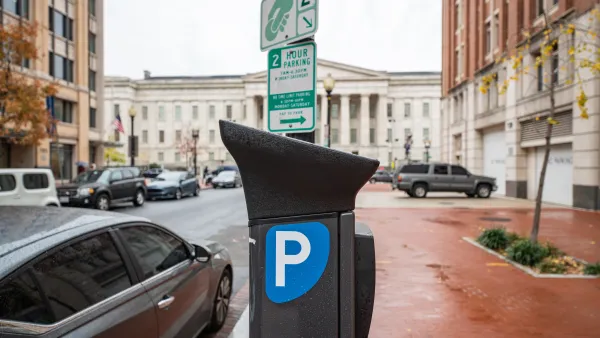
D.C. Residents Heavily Subsidize Residential Parking
The District is losing out on hundreds of thousands in potential revenue while encouraging residents to store cars on valuable public land.

Planetizen Federal Action Tracker
A weekly monitor of how Trump’s orders and actions are impacting planners and planning in America.

The state-sanctioned urbicide of Austin
People don’t kill cities. Freeways do.

US to reduce Colorado River water deliveries to Mexico
A new Colorado Treaty amendment reduces Mexico’s Colorado River water allocation by 250,000 acre feet.

5 New England states march closer to 800 megawatt wind energy project
Securing federal approval for the project may be complicated under the Trump administration, which has historically been hostile towards domestic wind power.

Baltimore to break ground on $50 million Transit Priority Project
The project will bring faster bus trips, safer streets and better bike connections to Baltimore.

Airbnb launches $250 million 'last-dollar financing' housing accelerator, makes first investment in Austin
The company will put $6.4 million towards affordable housing development in Texas’ capital.

FREE Course: Walkable City 1: Why Walkability?
After describing his path towards focusing on walkability as the essence of good planning, Jeff Speck marches through his five principal reasons for making more walkable places.
Reinventing Malls: Planning Alchemy—Turning Gray Fields Into Gold
The course focuses on the opportunities and imperatives that shape reinvention of mall sites.

Eagle County Government
Harvard University Graduate School of Design
Nashville Planning Department
The Architects Foundation
University of Cincinnati Online
The Pocatello Development Authority
The Urban Renewal Agency of the City of Pocatello
Journal of the American Planning Association