To alleviate tourist traffic and serve residents, the Regional Transportation Commission of Southern Nevada has unveiled a long-term plan to invest billions in transit improvements including light rail and an expanded monorail.


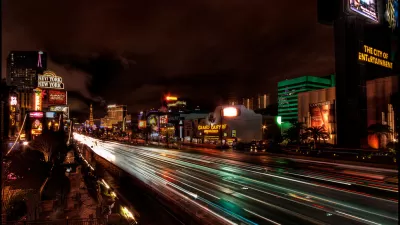
Prompted by clogged traffic on the Las Vegas Strip and a desire to keep pace with transit-invested peer cities, "the 30-year transit plan released by the Regional Transportation Commission proposes light rail in the resort corridor, an expanded monorail that would connect the major convention centers and various roadway improvements, among other projects," according to an article by J.D. Morris.
Morris writes, "The goal is to prevent the Las Vegas area's roadways from becoming overwhelmed by the anticipated growth in visitation and resident population in future years [...] Currently envisioned to connect the Strip, downtown and the airport, light rail could cost from $2.1 billion to $12.5 billion. Jeremy Aguero of Applied Analysis said the costs vary widely depending on whether the system would be built at, above or below street level."
Despite questions around funding, the long-term investment might pay off. From the article: "the transit proposals would have a projected total economic impact of $56 billion to $178 billion, and they could create as many as 122,000 jobs, according to the commission."
Read the full story: RTC unveils long-ranging transportation plan that includes light rail

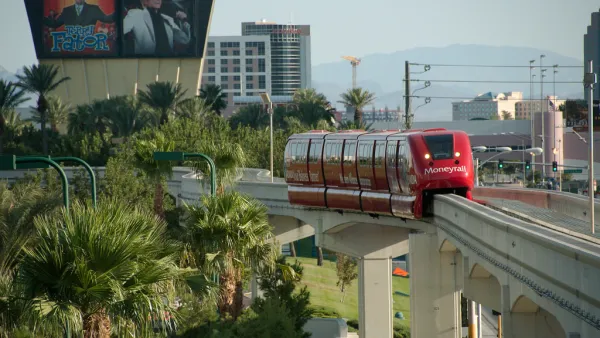
Las Vegas Light Rail Plans Take a Big Step Forward
The Regional Transportation Commission of Southern Nevada has proven its seriousness about an ambitious proposal to build a light rail connection between McCarran International Airport and the Las Vegas Strip.
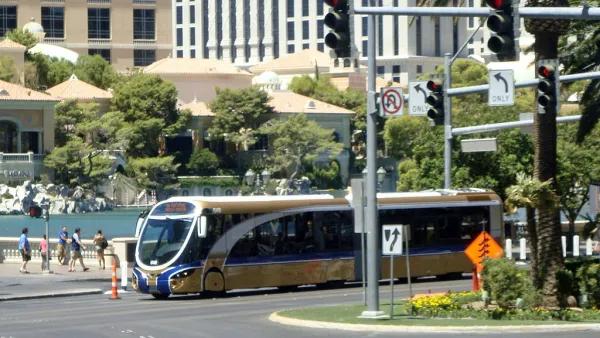
Bus Transit Used to Be Profitable on the Las Vegas Strip
The Regional Transportation Commission is looking for ways to reverse ridership figures that have plummeted since the advent of transportation network companies.
Calculating Bus Stop Spacing for 43 U.S. Cities
New research documents the distance between bus stops in U.S. cities—a key question for service designers that determines a lot about the public transit user experience.

Planetizen Federal Action Tracker
A weekly monitor of how Trump’s orders and actions are impacting planners and planning in America.

Amtrak, CN end decades-long dispute with eight-year agreement
The new operating agreement establishes an updated framework for the companies to work together, including processes to resolve disputes.

Northwest rail fans eager for Sept. 30 debut of Amtrak’s Airo fleet
Get ready for that new train smell and more seats. But they won’t go faster or run more frequently on the Cascades route in Washington and Oregon.

St. Louis Metro to test if single-car trains can reduce operating costs, maintain rider satisfaction
The pilot program will run from October to spring 2027, and begin with one single-car train operating on Metrolink’s Red and Blue lines.

Pennsylvania is building data centers in abandoned mines
Housing data centers in mines provides an alternative to destroying local forests and may spare residents from data centers’ noise and air pollution.

If Corpus Christi can’t revive desalination plant project, it may owe Texas $235 million
Earlier this month, city officials declined to pursue developing the plant for the second time in a year.

FREE Course: Walkable City 1: Why Walkability?
After describing his path towards focusing on walkability as the essence of good planning, Jeff Speck marches through his five principal reasons for making more walkable places.
Reinventing Malls: Planning Alchemy—Turning Gray Fields Into Gold
The course focuses on the opportunities and imperatives that shape reinvention of mall sites.

City of Thousand Oaks
City of Wisconsin Rapids
Harvard University Graduate School of Design
The Architects Foundation
University of Cincinnati Online
The Pocatello Development Authority
The Urban Renewal Agency of the City of Pocatello