Known for its unique Moorish Revival architecture, and beset by a host of urban problems, the Miami suburb may have found its savior in Germane Barnes. The young architect and planner aims to revitalize the area without gentrifying it.



Situated north of Miami, Opa-Locka is known for its "Moorish" take on 1920s Art Deco design. It also harbors festering crime problems and a disadvantaged populace. The city has recently embraced Germane Barnes, a planner and architect who believes that revitalization need not bring about gentrification and displacement.
Since moving in as designer-in-residence, Barnes has taken on projects that he hopes will rekindle the city's image of itself.
In his words, "This experience has let me know that architecture can speak to and touch people and change things, regardless of what academia or what the old guard may want you to believe [...] What starts as a grand proposal may need to be scaled back, big time. So now, we may only do three or four projects instead of a dozen, but it helps us focus on things we can change instead of spinning our wheels."
Barnes' completed projects include an arts and recreation center, a community park, and a high-impact repainting project on Ali Baba Avenue, one of the neighborhood's main thoroughfares. "His next series of projects, including a community garden and urban farm as well as a proposed series of public houses, open studio spaces meant for the community, aim to provide much needed infrastructure and fresh food."
Read the full story: How Urban Planner Germane Barnes is Reviving a Forgotten Miami Suburb

More money, less service: Miami-Dade slashes bus routes after hiking fare
The department is facing a multi-million dollar funding gap.

Miami Considers Airport-to-Port Train to Ease Cruise Ship Traffic
Miami’s port is one of the world’s busiest cruise ship terminals.
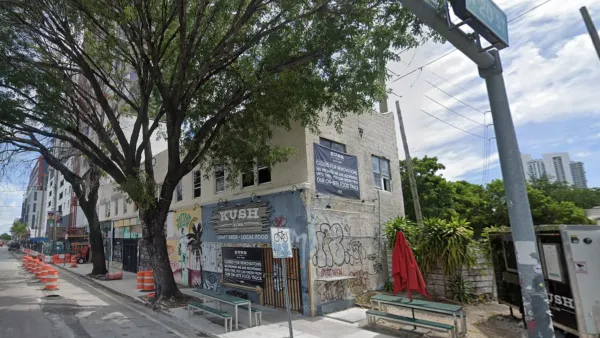
Miami Restaurant Rebuild Includes 10 Units of Affordable Workforce Housing
The restaurant’s owner worked with a local community redevelopment agency to preserve a historic building.

Planetizen Federal Action Tracker
A weekly monitor of how Trump’s orders and actions are impacting planners and planning in America.

California plans to bury El Niño’s downpour
If the state plays its cards right, it may be able to store a billion acre-feet of El Niño’s water in aquifers.

Desperate measures: Advocates weigh draining Lake Powell to fill Colorado River
Draining the reservoir could reduce evaporation losses by a couple hundred thousand acre-feet.

Chicago voters approve permanent festival grounds, penalty for vacant property owners
Currently, major summer and fall festivals take over public parks for weeks at a time, drawing criticism from nearby residents

NYC votes to cut outdoor dining red tape, speed up permitting
New York City also voted to allow the Department of Transportation to begin work on urgent projects before notifying elected officials.

California appears to reject Prop. 45
The proposition would have expanded the projects that qualify for a streamlined environmental review, effectively paring down the California Environmental Quality Act.

FREE Course: Walkable City 1: Why Walkability?
After describing his path towards focusing on walkability as the essence of good planning, Jeff Speck marches through his five principal reasons for making more walkable places.
Reinventing Malls: Planning Alchemy—Turning Gray Fields Into Gold
The course focuses on the opportunities and imperatives that shape reinvention of mall sites.

City of Rosemead
Rutgers University, Edward J. Bloustein School of Planning and Public Policy
One Hundred Miles
Hunter College, City University of New York (CUNY)
The Architects Foundation
University of Cincinnati Online
City of Cambridge
Montrose County
The Pocatello Development Authority