A 10-mile park that runs under the Miami Metrorail is nearly complete and features bioswales for water conservation and public recreation facilities.


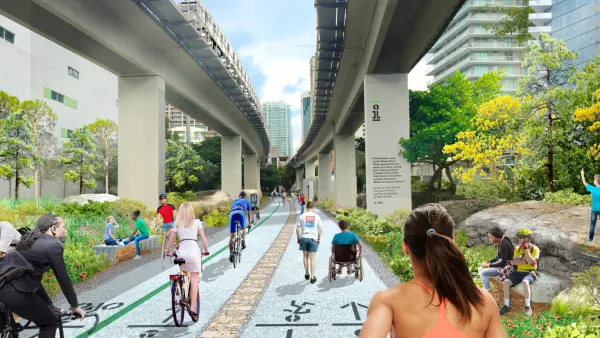
A 10-mile trail and linear park in Miami, set for completion in 2026, will feature bioswales for stormwater retention, hydration and bike repair stations, free WiFi, and more, reports Ysabelle Kempe in Smart Cities Dive.
The Underline, as it’s known, runs beneath the elevated transit tracks of the Miami Metrorail. According to Friends of The Underline CEO Patrice Gillespie Smith, “What I really admire about The Underline and what Meg [Daly], our founder, did is instead of trying to put it all on a road in quite an auto-centric community, she identified an underutilized space and said this is where our multimodal trail can go but also [be] a linear park.”
Smith adds, “It is first and foremost a transportation corridor. In most cases on the multimodal trail, the biking element is separated from the pedestrian element.” The project includes amenity areas such as a 50-foot “dining room table” designed for people to gather with friends and neighbors.
Smith says the project is also key to managing extreme storm events. “The bioswales are going to make sure that the water slows down, is cleaned and is able to return to the aquifer purified. The aquifer is our drinking source, so it’s very important.”
Read the full story: Inside Miami’s new linear park: Bioswales, bike paths and a 50-foot ‘dining room’ table
How to Make Greenways Better
Adding amenities such as public restrooms and shade trees can make greenways like Detroit’s Joe Louis Greenway more inviting and comfortable for their users.
Dreaming Big with Bike Infrastructure
A nationwide network of bike and pedestrian trails could give drivers new options for planning their next cross-country adventure.
Miami's Underline Receives a Major Gift
The Knight Foundation is supplying a significant cash infusion to Miami's version of the High Line.

Planetizen Federal Action Tracker
A weekly monitor of how Trump’s orders and actions are impacting planners and planning in America.

California plans to bury El Niño’s downpour
If the state plays its cards right, it may be able to store a billion acre-feet of El Niño’s water in aquifers.

Desperate measures: Advocates weigh draining Lake Powell to fill Colorado River
Draining the reservoir could reduce evaporation losses by a couple hundred thousand acre-feet.

Los Angeles just elected an urban planner as its mayor
Transportation analysts are optimistic that Raman will be more aggressive in addressing transit issues than Bass.

Mamdani’s pied-à-terre tax survives legal challenge
A panel of judges found that the plaintiffs failed to demonstrate injury as a result of New York City's implementation of the tax.

Eastern Nebraska is running out of electricity
Data centers and electrification are straining eastern Nebraska’s grid, throttling economic development.

FREE Course: Walkable City 1: Why Walkability?
After describing his path towards focusing on walkability as the essence of good planning, Jeff Speck marches through his five principal reasons for making more walkable places.
Reinventing Malls: Planning Alchemy—Turning Gray Fields Into Gold
The course focuses on the opportunities and imperatives that shape reinvention of mall sites.

City of Rosemead
Rutgers University, Edward J. Bloustein School of Planning and Public Policy
One Hundred Miles
University of Michigan School for Environment and Sustainability (SEAS)
Hunter College, City University of New York (CUNY)
The Architects Foundation
City of Cambridge
Montrose County
The Pocatello Development Authority