"Humanitarians are conditioned to think about people, urban planners are conditioned to think about how the place affects people."


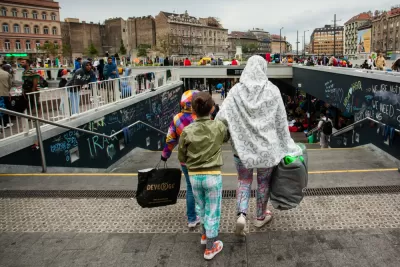
Increasingly, humanitarian crises are found in dense urban areas. Urban planner and International Rescue Committee worker Samer Saliba offers key urban planning insights to improve preparedness and response.
"Often, the most vulnerable people are moving to the most at-risk areas of cities-a problem exacerbated by climate change and the increasing risk of natural disasters. Similarly, the majority of forced migrants (refugees and internally displace) today are in urban non-camp settings."
Humanitarians must consider the importance of non-traditional actors, including civic and political agencies.
"To properly respond to urban crises, humanitarians must acknowledge political influences and appropriately work with political partners in order to achieve feasible solutions with greater reach. This does not mean abandoning humanitarian principles. It just means recognizing others as well… Ensuring the most vulnerable access the services they need in a way that improves those systems for all brings together urban planner and humanitarian objectives."
Saliba cites the Big U proposal to build a storm wall around lower Manhattan as well as the outdoor escalators of Medellin as examples of infrastructural projects that can improve the lives of a city’s most vulnerable populations.
Many planning principles are already embedded in humanitarian best practices. "Each seeks a higher quality of life for those they serve and each tries to improve on how it's done."
Read the full story: Ten urban planning principles every humanitarian should know

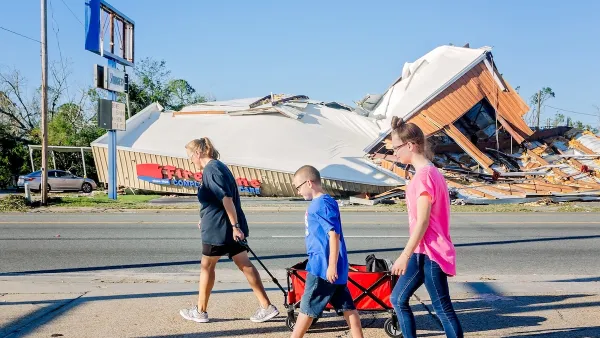
How ‘post-disaster gentrification’ alters neighborhoods after natural calamities
After hurricanes, fires or other calamities, the original residents of a community are often replaced by younger, wealthier residents.

Feds say robotaxis interfering with first responders is a 'functional insufficiency,' demand solutions by August
The NHTSA issued a letter to autonomous carmakers, noting that 'Every second matters when law enforcement officers, firefighters, or paramedics are answering a call.'

San Andreas fault at highest stress level in a millennium
A new study shows that the West Coast's major fault system is in 'a critically loaded state.'

Planetizen Federal Action Tracker
A weekly monitor of how Trump’s orders and actions are impacting planners and planning in America.

Amtrak, CN end decades-long dispute with eight-year agreement
The new operating agreement establishes an updated framework for the companies to work together, including processes to resolve disputes.

Northwest rail fans eager for Sept. 30 debut of Amtrak’s Airo fleet
Get ready for that new train smell and more seats. But they won’t go faster or run more frequently on the Cascades route in Washington and Oregon.

Brightline Florida files for bankruptcy
The transit company is over $5 billion in debt.

St. Louis Metro to test if single-car trains can reduce operating costs, maintain rider satisfaction
The pilot program will run from October to spring 2027, and begin with one single-car train operating on Metrolink’s Red and Blue lines.

Pennsylvania is building data centers in abandoned mines
Housing data centers in mines provides an alternative to destroying local forests and may spare residents from data centers’ noise and air pollution.

FREE Course: Walkable City 1: Why Walkability?
After describing his path towards focusing on walkability as the essence of good planning, Jeff Speck marches through his five principal reasons for making more walkable places.
Reinventing Malls: Planning Alchemy—Turning Gray Fields Into Gold
The course focuses on the opportunities and imperatives that shape reinvention of mall sites.

City of Thousand Oaks
City of Wisconsin Rapids
Harvard University Graduate School of Design
The Architects Foundation
University of Cincinnati Online
The Pocatello Development Authority
The Urban Renewal Agency of the City of Pocatello