Planning commissioners play an essential role in monitoring issues and projects of critical importance to the welfare of entire neighborhoods and cities. Why then, do so many commissioners seem to be sleeping on the job?



Ron Cohn has a recommendation for the Chicago Plan Commission that probably holds true for planning commissions around the country: wake up!
"I attended my first official Chicago public meeting yesterday," writes Cohn, "a Chicago Plan Commission public hearing, and I came away unimpressed. Not with the plans presented, which are glorious. With the Commissioners. If they were any less interested they'd need to have set alarms."
The article reads like a play-by-play of the hearing, much of which isn't only concerned with furthering Cohn's argument about the lack of interest from commissioners. One project in particular, notes Chon, deserved more scrutiny from the commission. "Not one question about a 93-story tower on East Wacker Drive. Open space? No. Traffic flow? No. Impact on schools? No. Timeline? No."
After speculating that maybe these planning commissioners consider it their job to let the pros do their job and let the project "move on down the road," Cohn doesn't mince his words:
"I can only tell you that as a Plan Commissioner for a small suburb on the North Shore I felt an obligation to read the material presented for the meetings, prepare myself as best I could to take part in an intelligent discussion about the project, and to engage architects and developers, to challenge them if necessary to make sure I got the best concessions I could, whatever they may be, no matter how much they had scraped and clawed to make it the best project they could. Because you can always do better. Nothing is perfect. And, as a Plan Commissioner, you usually only get one shot."
Read the full story: I Like the New Buildings Proposed in Chicago, But These Plan Commissioners Should Wake Up

Chicago Seeks Public Input on Clark Street Improvements
The city is creating a strategy for improvements in the Clark Street corridor to improve the area's walkability and stimulate the local economy.
A ‘shady’ deal: Chicagoans rally against planned Amtrak maintenance facility
The $900 million facility would allow Amtrak to maintain entire trains in one building, which the company says will reduce delays.
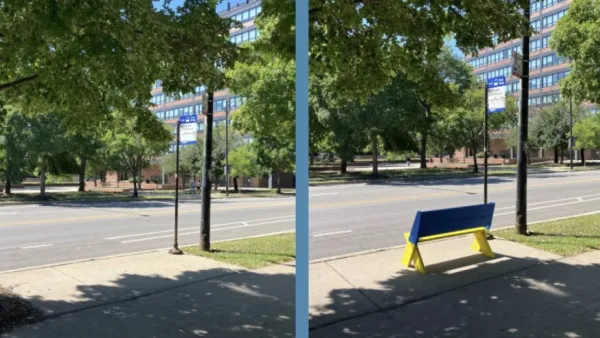
Guerilla urbanists are building DIY bus stop benches in Chicago
The new benches are not officially sanctioned or permitted, but the residents who placed them hope they will be the start of a network of DIY benches across the city.

Planetizen Federal Action Tracker
A weekly monitor of how Trump’s orders and actions are impacting planners and planning in America.

Amtrak, CN end decades-long dispute with eight-year agreement
The new operating agreement establishes an updated framework for the companies to work together, including processes to resolve disputes.

Judges permit Denver to divert 77,000 acre feet from the Colorado River for reservoir expansion
Overuse and climate change have caused the Colorado River’s water levels to plummet.

NYC DOT wants faster, more permanent street upgrades
The city is examining ways to build more concrete infrastructure without getting entangled in 'decades-long' projects.

'Something we’ve never seen before:' rising utility rates could strain city finances nationwide
Data centers, climate change and other factors have caused utility rates in the United States to increase by 38% since 2020.

Trump to overrule local leaders, lease millions of acres of America’s Pacific Island territories’ seafloors to mining companies
International law says that the Indigenous people of America’s territories have a right to prior and informed consent regarding projects that impact their countries.

FREE Course: Walkable City 1: Why Walkability?
After describing his path towards focusing on walkability as the essence of good planning, Jeff Speck marches through his five principal reasons for making more walkable places.
Reinventing Malls: Planning Alchemy—Turning Gray Fields Into Gold
The course focuses on the opportunities and imperatives that shape reinvention of mall sites.

Harvard University Graduate School of Design
KFH Group Inc.
Greater Baltimore Committee
The Architects Foundation
University of Cincinnati Online
The Pocatello Development Authority
The Urban Renewal Agency of the City of Pocatello