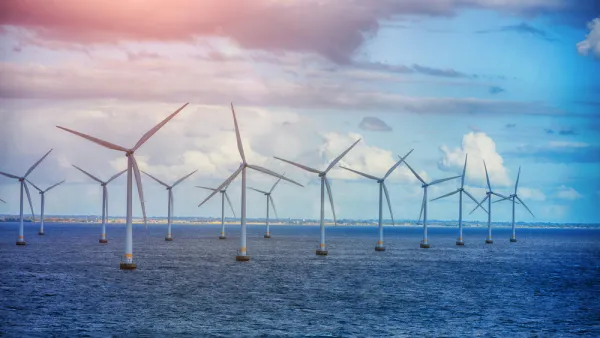
If a Seattle company gets its way, in a few years there will be 100 floating wind turbines about 15 miles off San Luis Obispo County on the central California coast, generating about 1 gigawatt of electricity.


The Trident Winds Offshore Wind Energy Project would be a "first" in at least two important ways: The first offshore wind project on the West Coast, and the first floating wind farm in the U.S.

Credit: San Jose Mercury News
"Most offshore wind turbines around the world are fixed to the ocean bottom, usually with foundations held down by steel pilings to withstand huge waves and gale-force winds," writes Paul Rogers, science and environment reporter for the San Jose Mercury News. "Floating turbines are easier to install and less intrusive, supporters say."
A major benefit of the project is that it converts a fossil fuel albatross, a mothballed power plant into a producer of renewable energy.
The 100 turbines would be spaced about half a mile apart, covering 40,000 acres of ocean and linked together with underwater power cables. The electricity would be shipped through one power line buried in the ocean floor back to the Morro Bay Power Plant, a former PG&E facility that was shuttered in 2013 but is still connected to existing transmission lines.
One compelling reason to approve the project, as well as other large renewable projects in California, is legislation (SB 350) requiring California to produce half its electricity from renewable sources in 15 years.
The biggest hurdle facing the project, as with other offshore wind farms, may be the aesthetics—the impact on the coastal "viewshed." Rogers has quotes from many environmental groups, some in support, some more cautious. His interviews comprise one of the most interesting parts of the article.
One of the more telling interviews is with a Santa Barbara group. Some say that it was in Santa Barbara that "the modern environmental movement was born in 1969, with a 4-million-gallon oil spill." Readers may recall the 100,000 gallon oil spill along the Santa Barbara coast from a pipeline rupture in May.
It sounds really, really horrible. This is a fairly massive project," said Susan Jordan, director of the California Coastal Protection Network in Santa Barbara. "California places a great deal of value on the Pacific coastline and what it looks like when you travel there. People don't want to look out and see a floating industrial facility."
Other floating wind farms:
"There are three floating turbines off the coast of Japan and one off Norway," and Scotland will also have five large turbines to be built by Statoil, a Norwegian oil and gas company, expected to begin producing energy in 2017, writes Rogers.
A proposed offshore wind farm project near Coos Bay, Oregon, also using floating turbines, does not appear to be going forward according to Breaking Energy last June.
Read the full story: California's first offshore wind farm proposed near Hearst Castle

Oregon Voters Support LNG Export Facility
A proposed $7.5 billion facility to export liquefied natural gas (LNG) from Oregon's south coast received a resounding vote of support on Tuesday from Coos County voters who rejected a ballot measure that would have banned its construction.
Proposed Offshore Wind Project Could Be the West Coast’s Largest
If approved, the plan to build a 2,000-megawatt facility off the coast of Washington State would be a milestone for floating offshore wind production in the United States.
San Luis Obispo County Leaders Ponder What's Next After Transportation Measure Fails
The November 8 sales tax measure fell 0.37 percent short, but there's new hope from Sacramento with the reintroduction of a gas tax measure. Democrats now hold the bare supermajority in both the Assembly and Senate needed to pass tax increases.

Planetizen Federal Action Tracker
A weekly monitor of how Trump’s orders and actions are impacting planners and planning in America.

Amtrak, CN end decades-long dispute with eight-year agreement
The new operating agreement establishes an updated framework for the companies to work together, including processes to resolve disputes.

Northwest rail fans eager for Sept. 30 debut of Amtrak’s Airo fleet
Get ready for that new train smell and more seats. But they won’t go faster or run more frequently on the Cascades route in Washington and Oregon.

A 'dangerous' precedent: North Carolina successfully pressures communities into voting for toll roads
Two mayors resigned from the Charlotte Regional Transportation Planning Organization after it voted in favor of the toll roads.

Austin landlords only need to address mold when it covers 25 sqft. A resolution looks to change that
The city manager will propose updates to the city code regarding regulations around mold in May.

NYCHA’s green future? Officials open ‘showroom’ apartment with sustainable features
Heat pumps, inductions stoves and infrared heating panels: these are a few of the climate-friendly upgrades being installed at some public housing developments, with more to come, officials said Tuesday.

FREE Course: Walkable City 1: Why Walkability?
After describing his path towards focusing on walkability as the essence of good planning, Jeff Speck marches through his five principal reasons for making more walkable places.
Reinventing Malls: Planning Alchemy—Turning Gray Fields Into Gold
The course focuses on the opportunities and imperatives that shape reinvention of mall sites.

City of Thousand Oaks
City of Wisconsin Rapids
Harvard University Graduate School of Design
The Architects Foundation
University of Cincinnati Online
The Pocatello Development Authority
The Urban Renewal Agency of the City of Pocatello