Fears that low gas prices and increasing vehicle miles traveled would negatively affect transit ridership might have come true in the first half of the year, according to data provided by the American Public Transportation Association.


Progressive Railroading reports: "While total public transit ridership decreased 0.9 percent during the first six months of 2015 compared with the same period last year, heavy-rail ridership rose 0.5 percent, according to the American Public Transportation Association's (APTA) most recent ridership report."
"A total of nine out of 15 heavy-rail systems reported increases. Cities logging rail ridership increases included San Francisco, up 4.3 percent; Atlanta, up 3.1 percent; and Jersey City, N.J., up 2.1 percent," adds the post.
APTA President and Chief Executive Officer Michael Melaniphy provides a soundbite in the post, speculating that some of the 50 million fewer rides in the first half of 2015 might be because people have returned to driving as gas prices have dropped.
Astute Planetizen readers will recall the debate that followed 2014's report on transit ridership from the APTA, which claimed record levels of transit ridership.
Read the full story: APTA: 5.3 billion transit trips in first half of 2015; 71 percent of transit ballot initiatives pass

Report: 10.8 Billion Americans Rode Transit in 2014
The American Public Transportation Association (APTA) has released its annual report on public transit ridership. Although more Americans are taking public transit, the trend doesn't hold in every city.
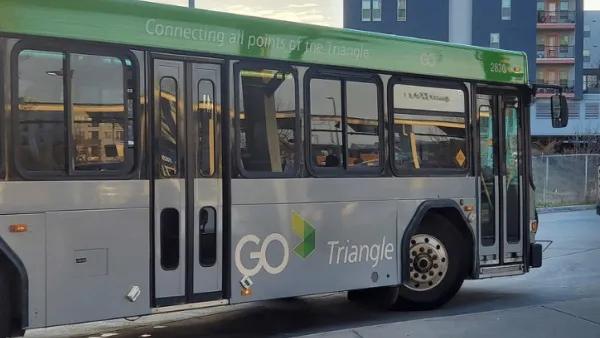
North Carolina Triangle transit ridership jumped 32% in April
Rising gas prices are prompting more Americans to consider public transit, where it's available.
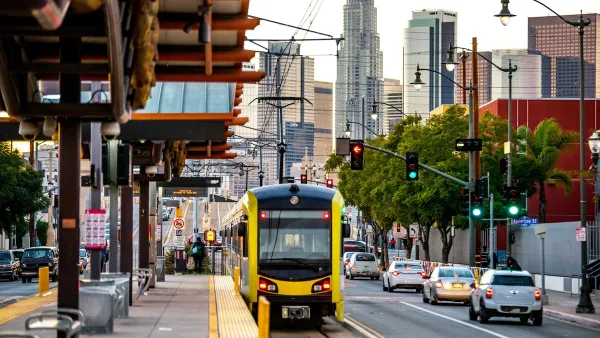
L.A. Transit Surpasses 1M Weekday Riders for First Time Since Pandemic
Rail and bus ridership in the Los Angeles metropolitan area is recovering at a faster rate than the national average.

Planetizen Federal Action Tracker
A weekly monitor of how Trump’s orders and actions are impacting planners and planning in America.

Amtrak, CN end decades-long dispute with eight-year agreement
The new operating agreement establishes an updated framework for the companies to work together, including processes to resolve disputes.

Judges permit Denver to divert 77,000 acre feet from the Colorado River for reservoir expansion
Overuse and climate change have caused the Colorado River’s water levels to plummet.

NYC DOT wants faster, more permanent street upgrades
The city is examining ways to build more concrete infrastructure without getting entangled in 'decades-long' projects.

'Something we’ve never seen before:' rising utility rates could strain city finances nationwide
Data centers, climate change and other factors have caused utility rates in the United States to increase by 38% since 2020.

Trump to overrule local leaders, lease millions of acres of America’s Pacific Island territories’ seafloors to mining companies
International law says that the Indigenous people of America’s territories have a right to prior and informed consent regarding projects that impact their countries.

FREE Course: Walkable City 1: Why Walkability?
After describing his path towards focusing on walkability as the essence of good planning, Jeff Speck marches through his five principal reasons for making more walkable places.
Reinventing Malls: Planning Alchemy—Turning Gray Fields Into Gold
The course focuses on the opportunities and imperatives that shape reinvention of mall sites.

Harvard University Graduate School of Design
KFH Group Inc.
Greater Baltimore Committee
The Architects Foundation
University of Cincinnati Online
The Pocatello Development Authority
The Urban Renewal Agency of the City of Pocatello