Maybe Halloween isn't the best night for it—but otherwise consider the weekend as a good time to get lost in a city.


Peter Watts writes about a an experimental social media walk for the Design Museum by first explaining the importance of getting lost:
"Getting lost is a valuable experience. Your senses are sharpened, you see more and remember more. I’m sure that getting lost sharpens the imagination – some might say that it’s only by getting lost that we can find ourselves, or some such pseudo-psychogeographical bullshit – but my interests are more material. Getting lost is fun. It’s interesting. It’s a great way to explore a city and learn how it is put together."
That's where the social media experiment comes in. Watts conceived of a way to use his phone to get lost, rather than stay constantly found.
"I conceived the idea of a walk that would be guided by social media. I’d take a starting pointing – which was obviously the Design Museum – and then ask my followers on Twitter where I should go: left, right or straight ahead. Every now and then I’d take a photograph but otherwise I wouldn’t reveal my location until the end."
Watts reports the (admittedly mixed) results of the experiment, and also provides some other tools and guidebooks for taking it one step past wandering into properly lost.
Read the full story: Getting lost is a great way to explore a city – but can you still do it in the age of the smartphone?
Mobility Data: How Your Travel Patterns Could Inform Policy
Data generated by travel modes can inform planners and regulators in improving the transportation system, but private mobility companies often restrict their access for concerns about privacy and competition.
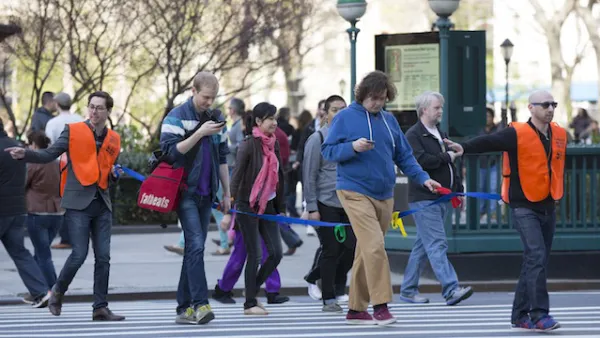
Safety Improvements for Texters Around the World
Cities are experimenting with safety measures for pedestrians who text while they walk, but the projects could benefit everyone.
Distracted Walking: Finally, Some Hard Data
It's serious, and the data is surprising. You need not be a pedestrian to experience injury while walking using your cell phone: half of all injuries occurred in the home. Two thirds of all walking-using-cell phone injuries were females.

Desperate measures: Advocates weigh draining Lake Powell to fill Colorado River
Draining the reservoir could reduce evaporation losses by a couple hundred thousand acre-feet.

Eastern Nebraska is running out of electricity
Data centers and electrification are straining eastern Nebraska’s grid, throttling economic development.

Malls are becoming the midtowns of the future
Mall and office park redevelopments are a generational opportunity to create new nodes of urbanity.

NYC breaks ground on anti-flooding infrastructure project
New York City's new system will reduce stormwater flows to local sewers by 90%.

One Kentucky town’s secret to affordable housing
The Smoketown Community Land Trust has already built seven affordable homes for community members.

Houston gains petal-shaped cooling infrastructure to make streets more ‘delightful’
The city has installed the pavilions along 15 blocks in Houston.

FREE Course: Walkable City 1: Why Walkability?
After describing his path towards focusing on walkability as the essence of good planning, Jeff Speck marches through his five principal reasons for making more walkable places.
Reinventing Malls: Planning Alchemy—Turning Gray Fields Into Gold
The course focuses on the opportunities and imperatives that shape reinvention of mall sites.

City of Rosemead
Rutgers University, Edward J. Bloustein School of Planning and Public Policy
One Hundred Miles
University of Michigan School for Environment and Sustainability (SEAS)
Hunter College, City University of New York (CUNY)
The Architects Foundation
City of Cambridge
Montrose County
The Pocatello Development Authority