Bloomberg details the sudden, catastrophic decline of the real estate market in North Dakota following the oil bust of the last year. Municipalities and investors are on the hook for thousands of new and approved building units.


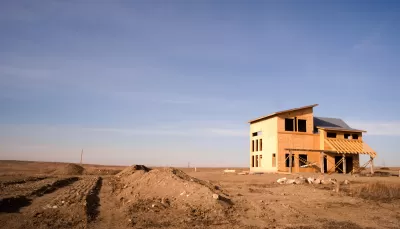
Jennifer Oldham reports: "After struggling to house thousands of migrant roughnecks during the boom, [North Dakota] faces a new real-estate crisis: The frenzied drilling that made it No. 1 in personal-income growth and job creation for five consecutive years hasn’t lasted long enough to support the oil-fueled building explosion."
As recently as last summer, media outlets were lining up to report on the "man rush" to North Dakota. The downturn in the oil industry has left many of those who came to seek employment during those times without work. Oldham writes: "More than 4,000 workers lost their jobs in the first quarter, according to the state’s Labor Market Information Center."
Now many of the city's once at the center of the boom resemble ghost towns: "As the migrant workers leave, their castoffs pile up in scrap yards such as TJ’s Autobody & Salvage outside Alexander, about 25 miles (40 kilometers) south of Williston. More than 400 discarded vehicles crowd its lot, including souped-up pickup trucks and an RV with rotting potatoes and a dead mouse in the sink."
Vacancies in "man camps" around the state have skyrocketed, forcing thousands of residential units to suddenly stall in the development pipeline. According to Oldham, "the average occupancy rate of new units in Williston was 65 percent in August, even as 1,347 apartments are under construction or have been approved there." Moreover, officials "in Watford City about 45 miles away have issued 1,824 permits for apartments, duplexes and homes in the past 18 months after only three houses were built between 1980 and 2000. They are in limbo, worried about filling the units."
FULL STORY: The Real Estate Crisis in North Dakota's Man Camps

North Dakota 'Man Rush' Compared to Historic Population Booms
Jens Manual Krogstad provides historical context for the migration to oil boom jobs in North Dakota by comparing the current "man rush" to the silver rush in late 1800s Colorado and the Alaskan oil boom of the 1970s.

Is the built environment partly to blame for population decline?
The way communities are designed could be contributing to lower birth rates.

US Population Growth Slowest Since 2020 Due to Declining Immigration
Net international migration dropped from 2.7 million to 1.3 million in the year spanning July 2024 to July 2025.

Planetizen Federal Action Tracker
A weekly monitor of how Trump’s orders and actions are impacting planners and planning in America.

The state-sanctioned urbicide of Austin
People don’t kill cities. Freeways do.

US to reduce Colorado River water deliveries to Mexico
A new Colorado Treaty amendment reduces Mexico’s Colorado River water allocation by 250,000 acre feet.

5 New England states march closer to 800 megawatt wind energy project
Securing federal approval for the project may be complicated under the Trump administration, which has historically been hostile towards domestic wind power.

Baltimore to break ground on $50 million Transit Priority Project
The project will bring faster bus trips, safer streets and better bike connections to Baltimore.

Airbnb launches $250 million 'last-dollar financing' housing accelerator, makes first investment in Austin
The company will put $6.4 million towards affordable housing development in Texas’ capital.

FREE Course: Walkable City 1: Why Walkability?
After describing his path towards focusing on walkability as the essence of good planning, Jeff Speck marches through his five principal reasons for making more walkable places.
Reinventing Malls: Planning Alchemy—Turning Gray Fields Into Gold
The course focuses on the opportunities and imperatives that shape reinvention of mall sites.

Eagle County Government
Harvard University Graduate School of Design
Nashville Planning Department
The Architects Foundation
University of Cincinnati Online
The Pocatello Development Authority
The Urban Renewal Agency of the City of Pocatello
Journal of the American Planning Association