The headline chosen here summarizes the argument put forward by Vox's Joseph Stromberg, who believes that self-driving cars will be a serious upgrade over the average human driver.


Joseph Stromberg writes an article supporting a claim that self-driving cars will provide enormous safety benefits to cyclists and pedestrians, citing the example of a biker who encountered a self-driving car in an intersection and did a track stand (an expert move that allows the cyclist to stand in place on the bike). The self-driving car barely moved as it tried to interpret the cyclist's small movements. Writes Stromberg:
"It's tempting to interpret all this as a sign of the steep learning curve Google's cars will encounter as they drive more in the complex conditions of the real world. But I think it shows something quite different.
Engineers will probably be able to teach the cars to distinguish between track stands and real movement fairly easily. But the cars will continue to drive with extreme caution and sensitivity, which is absolutely great news for cyclists and pedestrians."
Stromberg goes on to note that so far, experiments with self-driving cars have had the unintended consequence of providing evidence of the failures of human drivers. "As another Google post detailed, its cars frequently spot people driving on the wrong side of the road, dangerously turning across several lanes of traffic, and proceeding through intersections when there are still cars or cyclists in them. Human drivers zone out, miss cars in their blind spots, and often fail to spot bikes and pedestrians. This is part of why more than 30,000 people die in traffic crashes in the US each year," according to Stromberg.
Read the full story: Why Google's self-driving cars will be great for cyclists and pedestrians

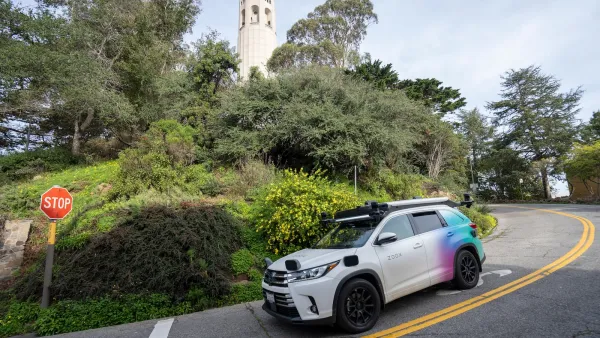
Feds want to make brake pedals optional in AVs
A proposed rule change would no longer require carmakers to include manual brake pedals or steering wheels in fully self-driving cars.
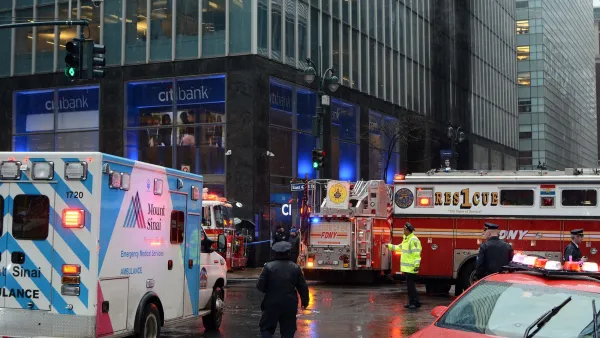
Waymo's troubles with emergency vehicles are getting worse
In one case, first responders waited 53 minutes to reach a Waymo support representative during an emergency.
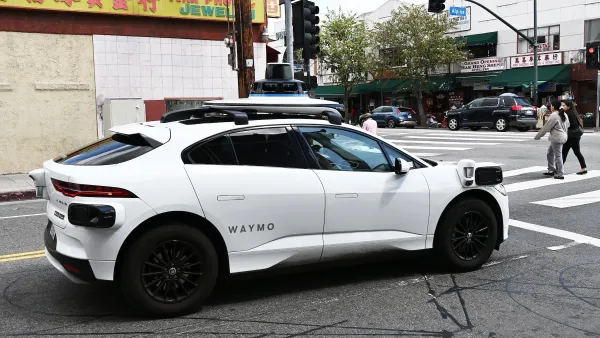
California cops will start ticketing robotaxis
The California DMV issued new guidance that allows law enforcement to give autonomous cars a "notice of noncompliance" when they break traffic laws.

Planetizen Federal Action Tracker
A weekly monitor of how Trump’s orders and actions are impacting planners and planning in America.

Amtrak, CN end decades-long dispute with eight-year agreement
The new operating agreement establishes an updated framework for the companies to work together, including processes to resolve disputes.

Northwest rail fans eager for Sept. 30 debut of Amtrak’s Airo fleet
Get ready for that new train smell and more seats. But they won’t go faster or run more frequently on the Cascades route in Washington and Oregon.

Brightline Florida files for bankruptcy
The transit company is over $5 billion in debt.

St. Louis Metro to test if single-car trains can reduce operating costs, maintain rider satisfaction
The pilot program will run from October to spring 2027, and begin with one single-car train operating on Metrolink’s Red and Blue lines.

Pennsylvania is building data centers in abandoned mines
Housing data centers in mines provides an alternative to destroying local forests and may spare residents from data centers’ noise and air pollution.

FREE Course: Walkable City 1: Why Walkability?
After describing his path towards focusing on walkability as the essence of good planning, Jeff Speck marches through his five principal reasons for making more walkable places.
Reinventing Malls: Planning Alchemy—Turning Gray Fields Into Gold
The course focuses on the opportunities and imperatives that shape reinvention of mall sites.

City of Thousand Oaks
City of Wisconsin Rapids
Harvard University Graduate School of Design
The Architects Foundation
University of Cincinnati Online
The Pocatello Development Authority
The Urban Renewal Agency of the City of Pocatello