A 72-unit development in Rotterdam—the town in upstate New York, that is, not its namesake in The Netherlands, is one of the first in the United States to be called net-zero: it consumes as much energy as it produces.


Surprisingly, netZero Village, "a community that produces as much or more energy than it consumes from renewable and sustainable sources," is a rental community. Phase One, composed of 72 units, became available this spring and has been fully rented.
"During the day, they’re generating selling [sic] energy into the grid," writes Andrew Murphy for News 10 ABC of Albany, N.Y. "At night or when it’s cloudy or snowy, consuming it, and at the the end of the year Bruns says his complex will net zero, or create as much as it consumes." See YouTube video.
For developer David Bruns, this environmentally friendly apartment community is a marriage of two passions, his engineering and residential real estate background. “I wanted to prove that a net zero development would be financially viable on a commercial level,” Bruns tells News 10.
Planning took three years and this Rensselaer Polytechnic Institute (RPI) grad says his apartments are engineered, modeled, and tested so he knows how much energy they’re going to use. “The way that buildings are being built right now, it’s just a shame in terms of energy efficiency,” Bruns says.
The six-building complex broke ground on October 28, 2014. Joining Bruns at the event (see 9-photo gallery) was local Democratic Congressman Paul Tonko.
While Murphy writes that the project "is considered the first of kind in the country,"
Wondering how much the units cost to rent? "One bedrooms go for $1195 and two bedrooms $1385, however all utilities are included," writes Murphy. All 72 apartments rented in three months. But that's only Phase One.
A second phase of seven buildings with 84 units is under construction and expected to open in June 2016.
Established by Dutch settlers in 1820, "Rotterdam is a town in Schenectady County, New York," according to Wikipedia. "The population was 29,094 at the 2010 census." It is part of the Albany-Schenectady-Troy, NY Metropolitan Statistical Area referred to as the Capital District.
Hat tip to Eric Wolff, POLITICO energy reporter and author of Morning Energy.
Read the full story: Net-Zero energy community in Rotterdam opens
Is Energy Efficiency the New Granite Countertop?
John McIlwain explores the market for energy efficient housing, and finds growth across the country.
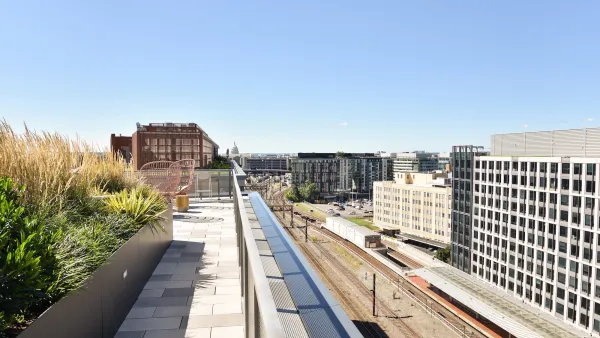
DC energy efficiency rule requires buildings to upgrade their infrastructure or face millions in fines
Building owners and condo co-op members say the upgrades are often prohibitively expensive.

Oregon Requires Energy-efficient Heat Pumps in New Housing
A new state law is expected to save residents an average of $125 per month on energy costs.

Planetizen Federal Action Tracker
A weekly monitor of how Trump’s orders and actions are impacting planners and planning in America.

California plans to bury El Niño’s downpour
If the state plays its cards right, it may be able to store a billion acre-feet of El Niño’s water in aquifers.

Desperate measures: Advocates weigh draining Lake Powell to fill Colorado River
Draining the reservoir could reduce evaporation losses by a couple hundred thousand acre-feet.

Los Angeles just elected an urban planner as its mayor
Transportation analysts are optimistic that Raman will be more aggressive in addressing transit issues than Bass.

Mamdani’s pied-à-terre tax survives legal challenge
A panel of judges found that the plaintiffs failed to demonstrate injury as a result of New York City's implementation of the tax.

Eastern Nebraska is running out of electricity
Data centers and electrification are straining eastern Nebraska’s grid, throttling economic development.

FREE Course: Walkable City 1: Why Walkability?
After describing his path towards focusing on walkability as the essence of good planning, Jeff Speck marches through his five principal reasons for making more walkable places.
Reinventing Malls: Planning Alchemy—Turning Gray Fields Into Gold
The course focuses on the opportunities and imperatives that shape reinvention of mall sites.

City of Rosemead
Rutgers University, Edward J. Bloustein School of Planning and Public Policy
One Hundred Miles
University of Michigan School for Environment and Sustainability (SEAS)
Hunter College, City University of New York (CUNY)
The Architects Foundation
City of Cambridge
Montrose County
The Pocatello Development Authority