Deb Hubsmith, who went from executive director of the Marin Bicycle Coalition to state and federal bicycle advocacy positions, passed away on August 18. She was known throughout California as being a tireless force for the advancement of bicycling.


"Deb Hubsmith, an energetic force who helped push bicycling to the fore in Marin County and across the country, died Tuesday of acute myeloid leukemia at her home in Fairfax," writes Mark Prado for the Marin Independent Journal. "She was 46."

"Ms. Hubsmith also helped lead the development of the Marin County Safe Routes to School program and then participated in an effort to establish it throughout California," writes Prado.
She then led the advocacy effort to pass the first Safe Routes to School legislation by the U.S. Congress, resulting in $1.1 billion for the program in every state. She also founded the Safe Route to Schools National Partnership made up of 750 organizations.
The partnership is "a nationwide program that is saving the lives of children endangered by reckless drivers," writes Streetsblog's managing editor, Brad Aaron, in their tribute to this bike hero.
"Deb was a force of nature, a leader at the root of an entire movement," writes Shannon Tracey, communications director for Oakland-based TransForm in a stirring recounting of Ms. Hubsmith's remarkable talent and skill set.
Read the full story: Deb Hubsmith, force in Marin, national bicycle movement, dies
Is It OK to Charge Pedestrians and Bicyclists to Cross Toll Bridges?
The Golden Gate Bridge, Highway and Transportation District might charge pedestrians and cyclists using the bridge in a plan to keep the district, which also runs buses and ferries between San Francisco and Marin and Sonoma counties, solvent.
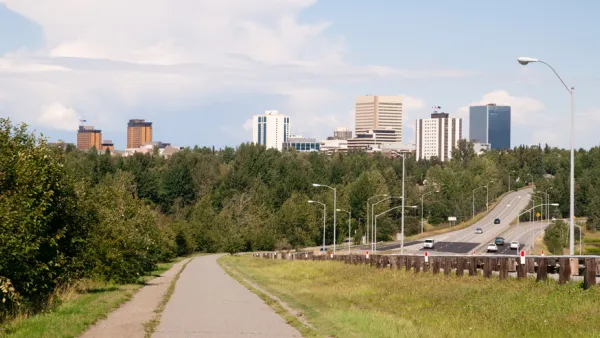
Will Alaska Return Millions of Dollars for Bike and Pedestrian Projects to the Feds, Again?
Last year, Alaska returned $2.6 million of its 2013 Transportation Alternatives Program funding to the U.S. Department of Transportation due to a shortage of eligible projects to fund, despite having four years to obligate the grant money.
Bike, Pedestrian Toll on Golden Gate Bridge Survives First Vote
The concept of tolling sidewalk access to the Golden Gate Bridge squeaked by on a 10-9 vote on Oct. 24. The GGB Transportation and Highway District wants to consider the toll as a potential contributor to reducing the $33 million, five-year deficit.

Planetizen Federal Action Tracker
A weekly monitor of how Trump’s orders and actions are impacting planners and planning in America.

California plans to bury El Niño’s downpour
If the state plays its cards right, it may be able to store a billion acre-feet of El Niño’s water in aquifers.

Desperate measures: Advocates weigh draining Lake Powell to fill Colorado River
Draining the reservoir could reduce evaporation losses by a couple hundred thousand acre-feet.

Los Angeles just elected an urban planner as its mayor
Transportation analysts are optimistic that Raman will be more aggressive in addressing transit issues than Bass.

Mamdani’s pied-à-terre tax survives legal challenge
A panel of judges found that the plaintiffs failed to demonstrate injury as a result of New York City's implementation of the tax.

Eastern Nebraska is running out of electricity
Data centers and electrification are straining eastern Nebraska’s grid, throttling economic development.

FREE Course: Walkable City 1: Why Walkability?
After describing his path towards focusing on walkability as the essence of good planning, Jeff Speck marches through his five principal reasons for making more walkable places.
Reinventing Malls: Planning Alchemy—Turning Gray Fields Into Gold
The course focuses on the opportunities and imperatives that shape reinvention of mall sites.

City of Rosemead
Rutgers University, Edward J. Bloustein School of Planning and Public Policy
One Hundred Miles
University of Michigan School for Environment and Sustainability (SEAS)
Hunter College, City University of New York (CUNY)
The Architects Foundation
City of Cambridge
Montrose County
The Pocatello Development Authority