The Wonkblog team puts new American Community Survey data to good use.



Katie Park, Ted Mellnik, and Emily Badger team up to share an interactive map (with data recently released from the American Community Survey) that illustrates the commutes of the 38 million Americans that cross county boundaries on their way to work.
"In the District of Columbia, for instance, about 95,000 workers come in each day from Fairfax County. Nearly 140,000 do from Prince George's County."
The article notes the limiting survey question that gathered the data: "At what person did this person work last week?"—which means that the data "may also capture a D.C. resident who went to a convention in Chicago the previous week, or a long-distance trucker who lives in California but spent that week driving across Ohio."
But there is still a lot to be gleaned from the map: "people from all over the upper Great Plains who spend Monday through Friday each week at lucrative fracking jobs in McKenzie County, North Dakota, or oil-industry hands who fly back and forth to Alaska's North Slope, or workers in the District who'd rather buy the bigger home they can afford in Pennsylvania."
Read the full story: Where Americans go to work when they don’t work near home

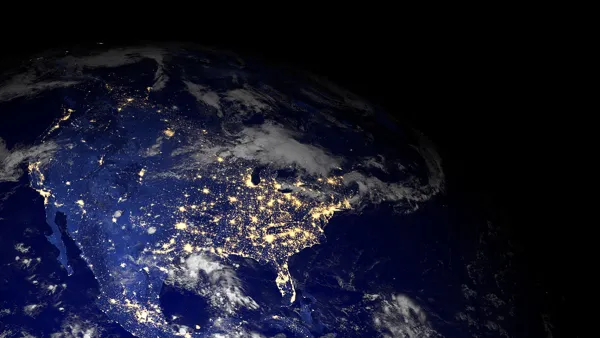
DataUSA: An Intuitive Tool for Public Data
A collaboration between Deloitte, Datawheel, and MIT has produced an intuitive aesthetically-pleasing gathering point for public data in the United States. Specific locations and industries boast easy-to-read profiles.
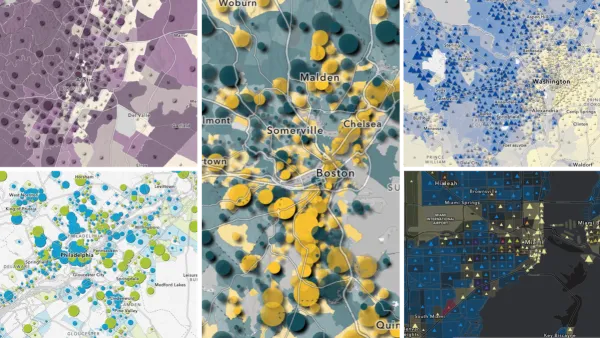
Explore US Demographics With the New ACS Atlas Collection
Esri's new ACS Atlas Collection offers interactive applications that visualize the latest U.S. demographic and socio-economic data, enabling users to explore over 175 curated web maps across various thematic areas.

A Milestone for the American Community Survey
After releasing new five-year estimates this week, the American Community Survey now offers three sets of five-year data that don't overlap, providing even more data for the analysis of local trends.

Planetizen Federal Action Tracker
A weekly monitor of how Trump’s orders and actions are impacting planners and planning in America.

The state-sanctioned urbicide of Austin
People don’t kill cities. Freeways do.

US to reduce Colorado River water deliveries to Mexico
A new Colorado Treaty amendment reduces Mexico’s Colorado River water allocation by 250,000 acre feet.

Nation's most wind-powered state turns to coal as data centers increase energy demand
For the first time in decades, Iowa has increased its generation of coal power.

NYC cools commuters with city's first rain garden above a bus stop
New York City officials say the plants in the rain garden can absorb 16 gallons of rainwater during heavy storms.

Brightline West’s future may rely on $6 billion federal loan
The company has until Nov. 2 to make a $400 million equity investment into its proposed high-speed rail line.

FREE Course: Walkable City 1: Why Walkability?
After describing his path towards focusing on walkability as the essence of good planning, Jeff Speck marches through his five principal reasons for making more walkable places.
Reinventing Malls: Planning Alchemy—Turning Gray Fields Into Gold
The course focuses on the opportunities and imperatives that shape reinvention of mall sites.

Greater Baltimore Committee
Eagle County Government
Harvard University Graduate School of Design
The Architects Foundation
University of Cincinnati Online
The Pocatello Development Authority
The Urban Renewal Agency of the City of Pocatello
Journal of the American Planning Association