The Core Values: Why American Companies are Moving Downtown report, released on June 18, 2015, provides in-depth analysis of a powerful trend of companies investing in urban downtowns.



"Hundreds of companies across the United States are moving to and investing in walkable downtown locations," according to a post on the Smart Growth America website announcing the releases of the Core Values: Why American Companies are Moving Downtown [pdf].
The report addresses questions like: "Why are companies choosing these places? What are the competitive advantages they see in these locations? And what features do they look for when choosing a new location?"
To generate the report, Smart Growth America examines nearly 500 companies that moved to cities between 2010 and 2015. Three findings emerge from the trend: 1) an "enormous diversity" of businesses are moving to downtowns, 2) relocations have taken multiple forms (e.g., relocations, expansions, consolidations, etc.), and 3) new locations are "dramatically more walkable."
A key takeaway from the report: that cities can learn from the decision making process of companies as they choose to locate in more urban areas and create places that set the stage for even more economic development in downtown locations.
Read the full story: Core Values: Why American Companies are Moving Downtown

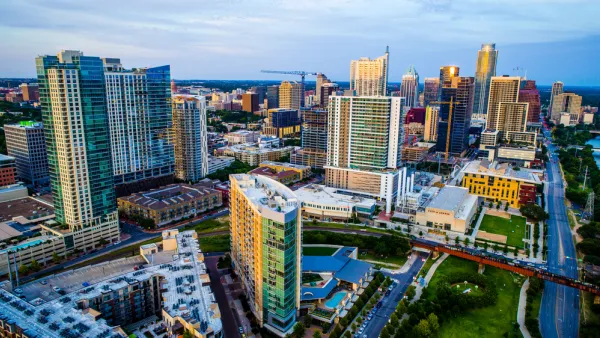
'Urban Luxury' Housing Skyrockets in Texas and Beyond
An explosion of upscale multifamily development in Texas cities reflects trends in the national housing market.

How Do Downtown Homes Prices Compare?
After a decade of shifting market preferences and an ongoing urban renaissance, how do downtown home prices compare in cities around the country?
Millennials Choose Cities for First Homes
New research suggests that millennials are remaining in urban areas as they transition from renting to homeownership.

Planetizen Federal Action Tracker
A weekly monitor of how Trump’s orders and actions are impacting planners and planning in America.

Amtrak, CN end decades-long dispute with eight-year agreement
The new operating agreement establishes an updated framework for the companies to work together, including processes to resolve disputes.

Northwest rail fans eager for Sept. 30 debut of Amtrak’s Airo fleet
Get ready for that new train smell and more seats. But they won’t go faster or run more frequently on the Cascades route in Washington and Oregon.

Brightline Florida files for bankruptcy
The transit company is over $5 billion in debt.

St. Louis Metro to test if single-car trains can reduce operating costs, maintain rider satisfaction
The pilot program will run from October to spring 2027, and begin with one single-car train operating on Metrolink’s Red and Blue lines.

Pennsylvania is building data centers in abandoned mines
Housing data centers in mines provides an alternative to destroying local forests and may spare residents from data centers’ noise and air pollution.

FREE Course: Walkable City 1: Why Walkability?
After describing his path towards focusing on walkability as the essence of good planning, Jeff Speck marches through his five principal reasons for making more walkable places.
Reinventing Malls: Planning Alchemy—Turning Gray Fields Into Gold
The course focuses on the opportunities and imperatives that shape reinvention of mall sites.

City of Thousand Oaks
City of Wisconsin Rapids
Harvard University Graduate School of Design
The Architects Foundation
University of Cincinnati Online
The Pocatello Development Authority
The Urban Renewal Agency of the City of Pocatello