On op-ed in the Oregonian makes the case for Portland to design and build a unique architectural icon that differentiates the city from its rivals in the Pacific Northwest.


"In public consciousness, most seem to associate [Portland] with our most publicized clichés: food trucks, biking culture and hipsters. But even if we can rightfully blame 'Portlandia' for perpetuating these clichés, it's hard to deny that there's nothing memorable about our skyline," according to an op-ed by Jason Shadel.
Shadel cites the economic impacts of icons like the CN Tower in Tornoto and the Gateway Arch in St. Louis to make the case for the potential of a unique architectural feature to define the skyline of cities and attract millions of tourists every year.
But, Shadel warns, Portland should endeavor to design an icon that fits the city's unique qualities:
I don't believe Portland needs a Space Needle. That would be counterproductive. The idea of erecting an iconic architectural structure — one that's not an office building and one featuring a publicly accessible viewing deck — is to further differentiate Portland from other regional cities like Vancouver and Seattle. This should be a challenge to architects to design something that's uniquely Portland, something that reflects the spirit of a city whose pioneering urban planning has emphasized density over sprawl.
Read the full story: Portland needs an architectural icon (OPINION)
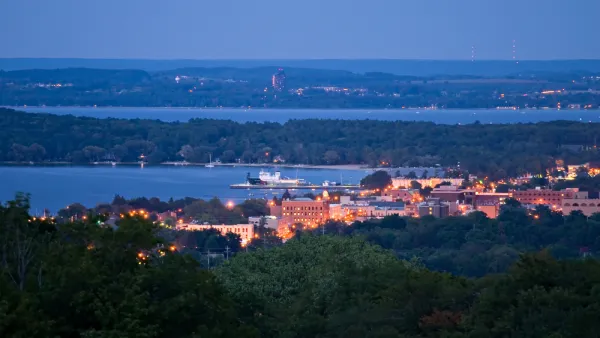
Sleepy Resort Towns Becoming Urban Destinations
Around the country, small, rural towns are experiencing the same political conflicts related to land use and planning more commonly associated with the city.
Icons Versus Places
Fred Kent of the Project for Public Spaces was recently entangled in a dispute with architect Frank Gehry over the impact of iconic architecture in cities. Though Gehry's work has its moments, Kent says city emphasis on icons is a mistake.
Portland to transform vacant landfill into energy-generating sanctuary
The project will boast hundreds of solar panels, and create jobs in Portland’s renewable energy industry

Planetizen Federal Action Tracker
A weekly monitor of how Trump’s orders and actions are impacting planners and planning in America.

California plans to bury El Niño’s downpour
If the state plays its cards right, it may be able to store a billion acre-feet of El Niño’s water in aquifers.

Desperate measures: Advocates weigh draining Lake Powell to fill Colorado River
Draining the reservoir could reduce evaporation losses by a couple hundred thousand acre-feet.

Los Angeles just elected an urban planner as its mayor
Transportation analysts are optimistic that Raman will be more aggressive in addressing transit issues than Bass.

Mamdani’s pied-à-terre tax survives legal challenge
A panel of judges found that the plaintiffs failed to demonstrate injury as a result of New York City's implementation of the tax.

Eastern Nebraska is running out of electricity
Data centers and electrification are straining eastern Nebraska’s grid, throttling economic development.

FREE Course: Walkable City 1: Why Walkability?
After describing his path towards focusing on walkability as the essence of good planning, Jeff Speck marches through his five principal reasons for making more walkable places.
Reinventing Malls: Planning Alchemy—Turning Gray Fields Into Gold
The course focuses on the opportunities and imperatives that shape reinvention of mall sites.

City of Rosemead
Rutgers University, Edward J. Bloustein School of Planning and Public Policy
One Hundred Miles
University of Michigan School for Environment and Sustainability (SEAS)
Hunter College, City University of New York (CUNY)
The Architects Foundation
City of Cambridge
Montrose County
The Pocatello Development Authority